


Can-Am, part of the Bombardier Recreational Products group (BRP), has been gradually introducing the latest generation of off-road utility vehicles, updating its Outlander ATVs and Traxter UTVs with new Rotax engines and driver comfort features. Over the last few years, this has seen the HD5 and HD7 Outlanders introduced, with XU specifications available.
Last summer, the company announced additional updates to its Traxter range, with a newly developed Rotax HD11 three-cylinder engine, rated at 999cc and producing 95hp. Alongside this, there was the revamped 6×6 Outlander, offered with a 650cc or 999cc engine, and a Backcountry model that boosts the top output from 82hp up to 101hp. Perhaps the headline announcement was the company’s first all-electric Outlander model, harnessing electric driveline knowledge from Can-Am’s wider recreational portfolio.
It was these three machines that we headed out to Barcelona to test, running various courses around the Les Comes off-roading venue. If we start with the electric model, Can-Am state that this is marketed to smaller farms (around 40ha) with operators riding around 30km/day. The company adds that it has a maximum range of around 80km, though the likely maximum will probably be closer to 50km as operators shift between two-wheel and four-wheel drive, tackle uneven terrain and difficult conditions, and utilise the 830kg towing capacity.
Externally, it looks like a standard Outlander, but instead of the Rotax engine, it is fitted with a Rotax e-Power unit and battery, producing the equivalent of 47hp. The battery is 8.9kWh and comes with a five year warranty, with an integrated 6.6kWh level 2 charging system. This means that farms with charging stations installed can charge between 20-80% in just 50min, according to the company, and 0-100% in 90min.
 If level 2 charging isn’t available, it can be plugged into a standard three-pin socket. This increases charging times to just over three hours from 20-80% and just over five hours for a 100% charge. Neither of these charging times will be particularly concerning as any extended period off the seat should be ample, whether this is split between morning and afternoon operations, or charging overnight.
Electric propulsion
There are a couple of minor changes when you get on the seat. Obviously, the dash has been adjusted to represent battery life and the number of kilometres left in the range, rather than a typical fuel gauge and tachometer. Bizarrely, the company has also moved the reverse gear. While it retains the lever to shift from high, low, neutral and park, the reverse is activated by holding down the start button and can be done on-the-fly when travelling under 20kph.
This is, frankly, unintuitive, and the amount of time you need to hold the start button felt inconsistent. In some cases, the system was unresponsive, requiring multiple attempts to shift into reverse.
Beyond this, it is very similar to a standard Outlander. The front rack can hold up to 54.4kg, while the rear can hold 109kg, and the suspension and ground clearance are comparable. The real differences come from the driving experience, the most obvious being just how quiet the machine is. As standard, it comes with XPS Recon Force tyres, specifically designed for this model, which limit the amount of noise you hear from the tyres, and the driveline has been reengineered to limit vibration and noise throughout.
This makes it a remarkably pleasant experience. We were able to talk with other riders without shouting and could hear more of our surroundings as we rode around the course. This all comes without any power limitations. The instant torque and power from the driveline mean that the all-electric Outlander can really move when you want it to. There are three driving modes (work, normal and sport) but none of these appeared to temper the acceleration of the unit, or it’s ability to handle muddy conditions or steep inclines.
Safety concerns
This does raise an issue, however. As impressive as the electric Outlander is, it does need to be approached with care. The acceleration is rapid, meaning those with the temptation to push their thumb right down risk having the front wheels lift and being thrown off the back.
Speaking with Jack Howard, ATV global product manager, he noted that the smart key system could be programmed at the point of purchase to limit the top speed and that this would see the acceleration pulled back to some extent, although whether this would eliminate the pull-back effect wasn’t certain.
Care also must be taken during the drive itself, as without a tachometer or any engine noise, it can be more difficult to gauge how hard you are accelerating. This will come as operators get used to the machine; however, on initial rides, the lack of typical pointers could lead to situations where the peak of inclines, or general obstacles, are hit at higher speeds than the rider may expect.
Underselling the range
Despite our concerns over potential safety hazards – something that could be addressed with revised rider training – our impressions of the all-electric Outlander were broadly positive. We couldn’t test towing or rack capacity, and how this could impact the range of the machine, but we felt that only marketing this to 40ha farms was underselling it.
We were the last to test the model on the day, meaning it had already done two extensive rides – eating into its range and tackling some steep inclines and muddy conditions. By the time we jumped on the seat, the Outlander predicted a remaining range of 21km and yet by the time we’d completed the course, which exceeded 10km, we had 15km remaining. The combination of regenerative braking and a smaller battery than you would see on other electric vehicles meant that we were able to recoup a not-insignificant number of kilometres to the range.
Then we should consider that those doing less intensive work with their ATV, working on primarily flat ground or doing scheduled work with livestock, will likely never reach the maximum range of this unit anyway. Even those pushing the range to its limit in a single day will be able to charge overnight to ensure they continue working the next.
Prices start at £15,99, which makes this one of the more expensive Outlanders – certainly more expensive than the rest of the mid-hp range – but it does offer a discount against the more powerful Outlander models, with comparable towing and capacity specifications even against the 6×6.
 Six-wheel drive
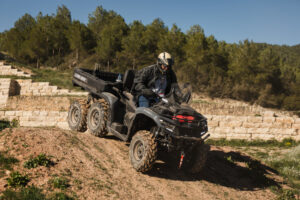
Speaking of the 6×6, we had the chance to drive two variants of the machine – the 50hp 650cc Outlander Max DPS 700 and the flagship Backcountry 1000R. These have very similar control layouts to the standard four-wheel Outlanders, with the key benefit being the increased rear deck capacity of 454kg, up to 25 litres of additional storage under the rear deck, and the general stability that comes with having a six-wheel chassis.
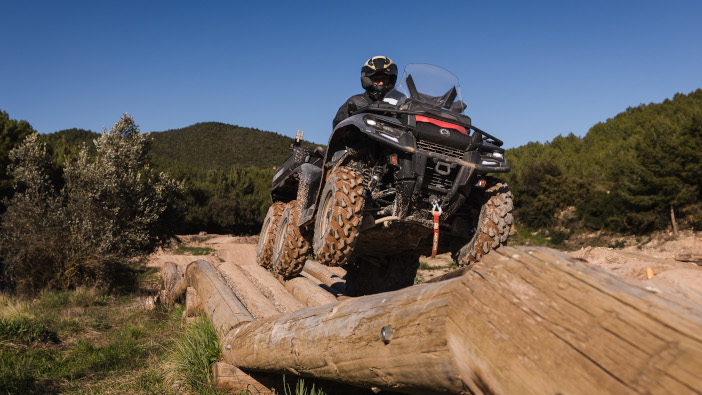
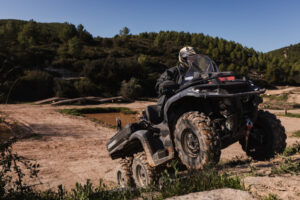
It’s easy to be blown away by the six-wheeler. The course took this machine into scenarios that it is hard to imagine any UK farm coming up against in day-to-day. With the Backcountry specifically, we climbed steep rock faces, tackled mud and standing water, and ran a wooden course designed to show how an off-road vehicle’s axle oscillates. At no point did we ever feel unstable or underpowered. There were even two conventional straw bales in the back, which never came close to falling out, even at the steepest points.
In his introduction to the machine, Jack noted that it had been tested extensively in Canada and the Nordics, suggesting that this machine is designed for far more challenging conditions than we are likely to see here.
The specifications include the in-house developed pDrive clutch, which is low maintenance and is said to provide improved backshifting and throttle response. Combined with a revised continuously variable transmission, the machine we tested was reactive and easy to control. Very rarely did we need to touch the brakes; instead, feathering the accelerator enabled us to come to a controlled stop even when heading downhill.
There was plenty of torque as well. Most of the obstacles were tackled at a standing start – due to the nature of the event – but both variants of the 6×6 took this in their stride.
Built to load
Little has been spared in the design of the 6×6. The new double a-arm suspension system offers up to 25.2cm of travel, and on the top two models, the arms are arched for greater comfort. The middle axle is fitted with a sway bar, and on the Backcountry, another is fitted on the front axle, and each machine offers 33cm of ground clearance.
You can also easily switch between four-wheel and six-wheel drive, although it was only in the most extreme cases that we needed the latter.
There are some nice practical features as well. Like the rest of the Can-Am range, these new models feature the LinQ quick-release options, enabling add-ons to be quickly attached and detached depending on the job. The rear box also has a hydraulically assisted tipper function, which can be upgraded to an electric system if required.
A 1,588kg capacity winch, with synthetic rope, is standard on the Backcountry, although it’s likely this will be pulling other vehicles out of tricky situations, and the sides of the box are removable, meaning it can be adapted to different loads.
 Where it fits
There were very few negatives to the driving experience of the 6×6. In fact, our only reservations were where it fits in the UK market. If you look at the smaller units first, these start at £17,299 and £19,649 respectively, more expensive than most of the other Outlander units and comparable to some entry-level Traxter UTVs. The Backcountry starts at £22,349, putting it in line with some of the HD9 and HD10 Traxter machines.
Compared to the four-wheel units, the six-wheeler has some benefits. The increased rear deck capacity makes it a useful tool for heading out to remote fencing jobs or livestock pastures, and the additional axle increases the stability for those having to face some difficult terrain.
When you look at the Backcountry, it’s hard to imagine areas in the UK that would call for such an intensive machine, and the increased price does make you wonder whether operators would be better opting for a step-up in comfort again and purchasing a Traxter instead, which can offer similar capacities with the benefit of a cab and additional room for passengers.
Driving side-by-side
The new generation HD11 Traxter sits at the top of the company’s side-by-side range, priced at £24,899 for the standard two-seater, and £27,499 for the extended chassis, four-seater model. Both are powered by the new Rotax HD11, three-cylinder, 999cc engine, offering 95hp and featuring an updated cooling system with a new intake and a variable speed fan.
The driveshaft has been uprated, with new engine modes for work, normal and sport, with eco mode dropped from this model.
The stepless transmission has been refined to offer easier shifting, and it comes with both the pDrive and QRS-X clutches, which Félix Bérard, global product strategy analyst, said would improve power delivery across the full speed range. Other driving improvements included a speed limiter programmed through the digital key and dynamic power steering with three modes.
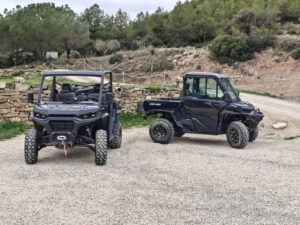 With the increased price tag, it’s clear that Can-Am is marketing this to the most intensive users and this shows in the build. The suspension has been widened to 165cm, with 50% larger arched a-arms. Double-bonded bushings have been used throughout as well to minimise squeaking. The ground clearance is 35.4cm to easily travel over most obstacles, and the suspension can travel up to 30.5cm at the front and rear.
It has a towing capacity of 1,111kg and a rear deck capacity of 454kg, with a total payload of 680kg.
Like the 6×6, this feels like a machine for those who have pushed their previous side-by-sides to the limit, which means a smaller market in the UK than the currently available Traxters. With that said, it is an impressive machine. The cabin is spacious and comfortable, even when driving over some very uneven terrain.
You have the choice of a fully enclosed cabin or a unit with nets at the entryways. In the dry, mild conditions we were driving in, both were perfectly fine, though in wet and cold weather, the doors would be preferable.
The control scheme is intuitive, and the gearbox reacted smoothly to the accelerator. Compared to the previous generation, the HD10, this was the most noticeable difference. The driving comfort is a step-up, with the HD11 accelerating to speed fast, decelerating quicker without the need for the brakes, and generally being smoother over the various bumps and undulations.
With such a hefty price tag – matching that of the six-wheel Traxter – it will take some justification from operators.