


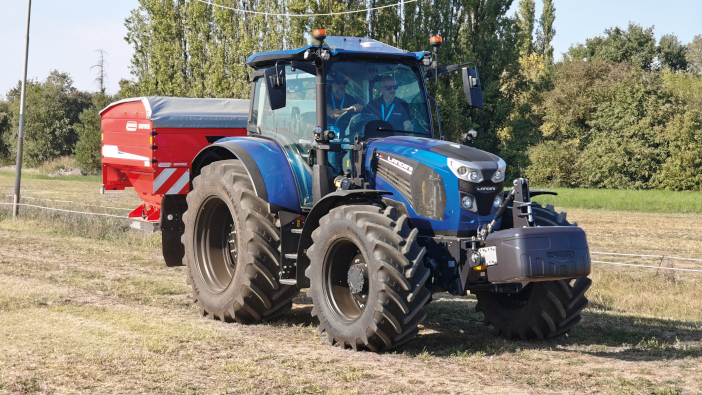
Argo Tractors has introduced a new 6RS range of tractors, bringing technology down from the larger McCormick ranges to the utility segment.
Argo Tractors has been reassessing how it promotes its brands across different markets. Looking at the UK and Ireland, for example, McCormick is often the preferred machine for England, Scotland and Wales, while Landini
continues to have a strong presence in the Irish market.
Landini remains available through the UK dealer network, although it is primarily on customer request. With that in mind, it’s worth noting that many of the updates seen on the 6RS will make their way into the equivalent McCormick models.
Two models are available: the 127hp 6-135RS and the 143hp 6-145RS. It uses the FPT F36 engine, with the 143hp
model reportedly being exclusive to Argo. Power is put to the ground through the Argo-designed Robo-Four or Robo-Six transmission. The first has four ranges, each with four powershift steps providing 16×16 forward and reverse gears, increasing to 27×27 when creeper gears are included.
The Robo-Six retains the four ranges, but bumps up the step changes to six, with a maximum number of 40×40 gears when a creeper box is fitted. On the Robo-Six unit, there are 13 speeds between the working speeds of 4-12kph. Both transmissions can reach 40kph at 1,600rpm and 50kph at 1,965rpm.
Automation has been integrated into the gearbox, with automatic shifting and a clutch-to-brake system. The braking system has also been uprated, with front and rear multidisc brakes and dual-line pneumatic or hydraulic trailing braking.
The basic specification keeps the machine simple, including an open-centre hydraulic system offering 77+39 litres/min, with the option of a closed-centre, loading-sensing pump offering 123 litres. A low-pressure circuit for ancillaries is rated at 47 litres/min. It’s possible for up to five rear remote valves to be equipped, with two electro-hydraulic spools, and up to three electro-hydraulic mid-mounts.
The rear hitch can lift 6,600kg, while the optional front hitch can handle 2,250kg.
Customers have the option of a four-speed rear pto over the standard two-speed, and the possibility of a
ground speed system. The front pto, when specified, runs at 1,000rpm.
 Built for loader work
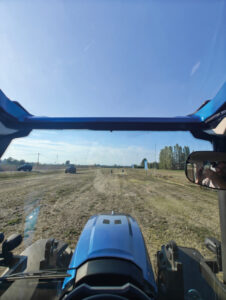
As a utility machine, the 6RS can be equipped with the company’s L30 loader, which can lift up to 2,000kg to a height of 3,870mm. This can be specified even when a front hitch and pto are equipped, and is controlled via the SmartPilot Plus joystick. To further bolster this functionality, the cabin can also be fitted with a glass roof hatch, improving visibility to the attachment and load.
Speaking of the comfort zone, it is a four-post unit, mounted on a mechanical suspension system with a panhard bar and rear shock absorbers with a stroke of 96mm. It is paired with a front suspension system designed by Argo, with three damping settings so it can be matched to the conditions.
On the right-hand side is the SmartPilot Plus joystick, which can handle transmission controls, activate the engine
speed memory functions, as well as hydraulic functions, pto engagement and the front and rear hitch. It’s possible to upgrade this to the DSM Plus system, which replaces the analogue dashboard with a new 12in digital cluster and adds a 12in touchscreen display to the cab instead of the 10in unit previously used.
Using the display, both the terminal and the cluster can be adjusted with real-time widget configuration and
customisable home pages. It brings with it Isobus compatibility and precision farming functionality. Notably, the
company has shifted to its own GPS, fleet management and precision farming systems, with its deal with Topcon due to run out at the end of this year.
According to Argo, this will enable it to offer a single system across the full Argo range, and it has created a new team to monitor and support the technology rollout.
Working in the field
Unfortunately, it wasn’t a particularly difficult test of the Landini. Two models were available to us, one with a fertiliser spinner and one with a mounted sprayer, neither of which were likely to give the machine much trouble, nor showcase its overall versatility. Having driven the previous generation of the Landini utility tractor, we know it can handle cultivation and is well equipped for loader work.
It did give us a chance to see how the new cab layout and systems felt and compare it to the Series 7 range, which was also in the field. One thing that stood out between the larger unit and the new 6RS is the style of joystick.
The Series 7 uses the EasyPilot, which is larger and has a rounded shape that curves to the left, allowing you to wrap your hand around it and have fingertip control of the buttons. The SmartPilot Plus is a more traditional joystick shape, and while this will be down to operator preference, we found the larger lever to be more intuitive when it came to field operations.
There is a solid reason for the redesign, however, as the SmartPilot Plus will also be used to control the front loader, when fitted. While we couldn’t test this on the day, the left and right movement with the smaller joystick
would clearly be easier to use.
When driving the tractor, there were a few gremlins that will hopefully be addressed before the full launch. A couple of the gear shifts in automatic mode jolted us a bit, to the point where it was smoother to manually shift up and down. However, this could be because of the small area we were operating in, as by the time the machine started to get up to speed, we had to slow down and start our headland turn.
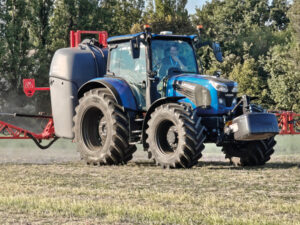 On the road, or with a larger load on the back, these jolts should be dampened considerably. This was confirmed by Landini when we asked about it. Field mode automatically shifts up at about 2,000rpm, designed for more taxing operations than carrying a fertiliser spreader.
There were also a few minor issues with the controls. There is currently no tactile button to engage autosteer, either on the armrest or the joystick. This is instead activated with a widget in the top-right corner of the DSM screen. This works fine, but you typically engage autosteer after completing a turn, which means you are controlling the steering, adjusting your speed and then reaching over to grip the terminal and press a touchscreen – which can be difficult in rough conditions.
Another button on the joystick, or even at the base, would likely feel far more intuitive and be easier to activate than the current system.
For the most part, however, the Landini 6RS is a comfortable and easy tractor to drive. The issues do not take away from the machine and should be easily addressed if the company consider them major enough that customers will struggle. The new cabin is comfortable, with great visibility, and while it lacks some of the high-tech additions we have seen in other brands, there is a lot to be said for a functional, easy-to-use tractor.
For those who want to take it to the next stage, Argo’s own precision farming system keeps much of the logic of the previous Topcon units, with smartphone functionality, and this is now easily integrated into its own fleet management system.
It will be interesting to see where Argo can take this technology in the future, as it is currently focused on offering a retrofittable system to suit every machine in its range, whether it is a compact unit that needs an electric steering module, a utility unit that is being used for fieldwork, or its high-horsepower tractors that need a full suite of systems.