


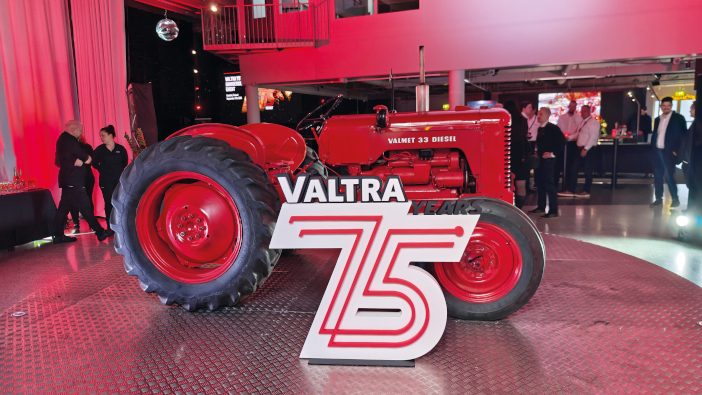
While there was a celebratory air within the Valtra factory during our visit, the focus was not on looking back. We got a taste of the history, including the first tractors to roll off the production line in 1951.
We were also given some facts and figures to highlight how the company has developed: 935,000 tractors sold globally since production started, 94% of the production was made for the export market, 60% went through the Valtra Unlimited customisation workshop, and the company’s efforts to reach net zero.
The focus, instead, was on the future of the business. Mikko Lehikoinen, managing director, noted one very
interesting fact. Valtra is the second-largest company in the robotics and automation sector in Finland.
Manufacturing is still a key part of the Valtra business, but it is only one part, and the company is focusing its efforts on the technology within its tractor portfolio.
“We want to make the complicated things easy,” Mikko explained.
As part of this direction of travel, many of the updates across the new T-series are focused on the user interface and related technologies.
Before we get to those, however, we should look at the build of the machine. There are six models in the range, sharing much of the driveline with its Agco sister companies – the Core75 Agco Power engine, offering outputs from 170hp to 245hp and up to 1,184Nm of torque, as well as the option of the ML 180 continuously variable transmission.
Each model is available with the stepless gearbox, with either an Active Gen2 armrest or the new-generation
SmartTouch display and armrest. A 10-speed powershift is also available for both specifications, as well as a
five-speed powershift on Active Gen2 machines.
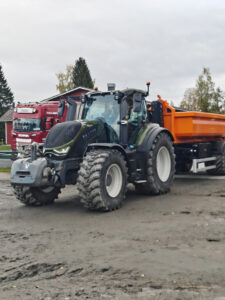 The powershift is split into two ranges, with automatic shifting to provide a CVT-style functionality, while benefitting from improved power transfer and reduced fuel consumption. The first range runs up to 21kph, making it ideal for field work, while the second range runs from 3.7kph up to the top speed of 57kph.
The engine response can be adjusted from the cabin, with three modes – Eco, Normal and Power – to optimise output and fuel consumption based on the operation.
Other functions have been added to the driveline, including a new hill hold. This is activated by pressing firmly down on the brake while at a standstill. The transmission will then hold the machine for a brief period, enabling a smooth changeover to the drive pedal for pulling away.
The cooling pack has been redesigned, with the option of a reversing fan to improve performance in particularly
dusty conditions. There is room for both the diesel oxidation catalyst and diesel exhaust fluid systems to be mounted under the hood. The rest of the after-treatment components are then mounted at the base of the exhaust, hidden from the operator’s view by the A-pillar to avoid affecting visibility.
The redesign has also shifted the timing gear to the rear of the engine block, enabling the waist-style bonnet to
be retained, providing a tight turning circle of just 4.9m.
Air suspension is standard, and the fuel tank has been increased to 380 litres, although if the steel variant is optioned for areas where damage is a possibility, this is reduced to 250 litres.
At the rear, the hydraulic system has a maximum output of 200 litres/min, and the rear linkage can lift 9.5t. Overall, the gross vehicle weight has been increased to 14t. CVT models can have a four-speed pto, and a ground-speed pto is available on the Powershift machines.
A smart touch
When Valtra first launched the SmartTouch armrest in 2017, it was a genuine selling point for the brand –
introducing smartphone functionality and greater levels of customisation to tractor displays.
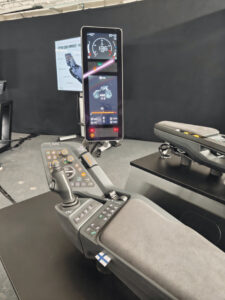
It’s fair to say the other brands have caught up in the nine years since then, so there was some excitement about how the new generation would push the technology forward. Arguably the biggest change is the shift to centralised processing. The computing power is now down by the operator seat and not integrated into the display. This means the display can boot up quicker and is more responsive during use. It also means multiple displays can be run at the same time without the need for additional processors.
It has benefits during work, as the company says more functions can be run simultaneously now.
Profiles can still be set up for operators and different tasks, allowing pre-set controls and display layouts to be quickly recalled. Main profiles can be starred and called back with one touch. The visual menu layout has been
refined, retaining that smartphone functionality, and the display can be fully customised using the drag-and-drop
system. The control scheme can also be adjusted, with six customisable buttons on the driver lever and an additional four on the hydraulic joystick.
A neat feature is the QR code generator, which can be scanned and will link to a mapping system to guide people directly to the field. Waylines can be overwritten to move around obstacles without stopping and recording new ones, and coverage guidance is available.
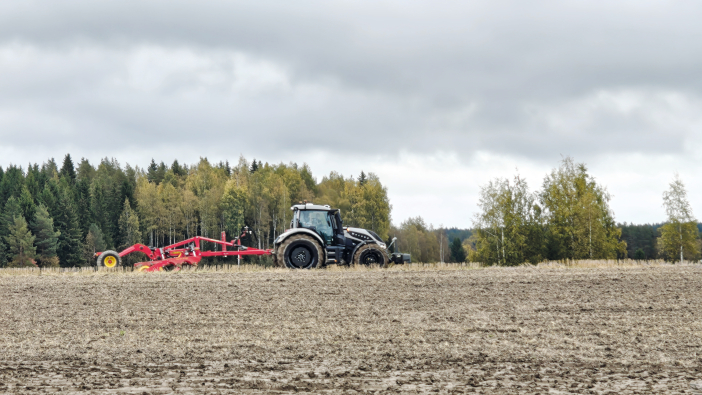
We didn’t get a huge amount of time on the seat, but the SmartTouch remained one of the easiest systems to use on the market. Its functionality is intuitive, and the tractor performed well, even in wet conditions. The drive was responsive, with easy switchover between the drive lever and the pedal.
One wonders, however, if the technology updates are enough to push Valtra as far ahead as it was. Change in the
tech sphere continues to move quickly, and there are plenty of systems available to customers now. However, the
centralised processing should make future updates easier to implement.
Interestingly, the company also briefly discussed an artificial intelligence (AI) chatbot function, allowing operators to ask questions about set-up and the use of the SmartTouch system. We wondered why farmers would need this when the system is designed to be easy to use.
Mikko said: “It’s part of making the system as easy as possible to use. For businesses that regularly use temporary
staff, or have workers who are used to other brands, the AI chatbot will help speed up the process of familiarising
themselves with the Valtra brand.”
It’s also worth noting that the updates to the Active armrest have brought it closer to the SmartTouch. Operators will rely more on the A-pillar display, meaning it is less pictorial than the larger SmartTouch display. It also lacks the drive lever design on the higher-spec model, but it is easy to use, keeps the customisable buttons and adds an easy-to-use encoder for shifting through menus.
PTx FarmEngage system
Not exclusive to Valtra, the FarmEngage system is a farm management data-transfer system available through Agco, which the company says will enable customers with mixed fleets to combine machine and work data into a single workflow.
It connects through APIs to other systems such as John Deere Connect and CNH’s FieldOps. Machine data from third-party companies is limited, just as Agco data is limited through API connections with those platforms, but the company says the task data sharing will significantly reduce the time spent moving information between tractors.
It is integrated into the SmartTouch Gen2 control scheme, sharing data through Valtra Connect, including
records of completed work. From the farm office, work planning can be completed and shared wirelessly to
machines, including task data, guidance lines and prescription maps.
Three levels of FarmEngage are available – Lite, Standard and Premium – with Agco customers receiving five
years of the Standard package free of charge when purchasing a new tractor.
 Unlimited Ultra
The new-generation T-series will be the first Valtra machine to be offered with the Unlimited Ultra package, which brings together a series of optional extras.
These include the full stack of precision farming systems, as well as creature comforts such as automatic air conditioning, the AutoComfort pneumatic cab suspension, new LED lighting, heated mirrors and a
right-hand window wiper.
It also includes the Isri TT Deluxe leather seat, with memory settings, heating and cooling functions, and a massage system. Customers can choose between a corner table or a 12-litre thermal coolbox under the
A-pillar, and the package is completed with a wireless charging phone holder, interior lighting and a gooseneck
microphone.
One novel option also available through the Unlimited Studio is a coffee machine – perhaps not so great
when bouncing over field ruts, but it is something that could make lunch breaks a little more luxurious.
system is designed to be easy to use.