


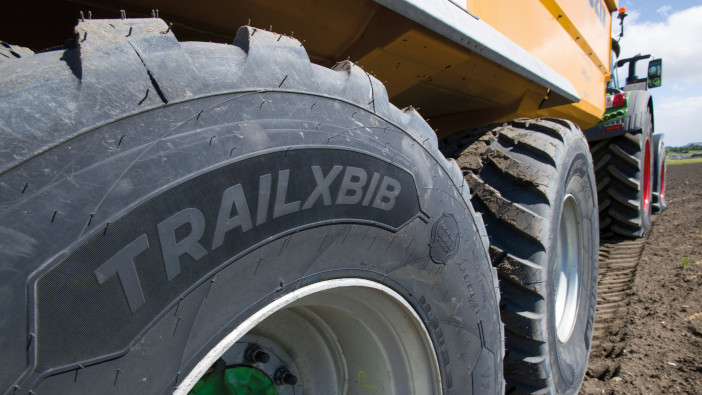
As the changing climate causes more extremes in heat and rain, choosing the appropriate combine tyre is more important than ever.
According to Tom Saunders, agricultural beyond road customer engineering support manager at Michelin, the majority of combine tyres will be chosen during the purchase of a new harvester and will likely stay on the machine until it is moved on from the farm, barring any major damage.
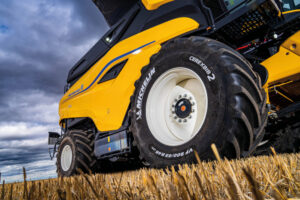
The company offers both the Cerex Bib and Cerex Bib 2, which are specifically designed to handle the high grain tank capacities and wider headers on modern equipment.
“Our range features Ultraflex very high-flexion [VF] and cyclic field operations [CFO+] technology – the latter allows the tyre to carry more load at 10mph in the field for up to 1.5km without changing the pressure,” he says. “This accounts for the increase in vehicle weight when the grain tank is full.”
He adds that the changing climate – with extremes in heat and rain – is making harvest more challenging for growers and contractors. As such, tyre choice should be a key consideration. When choosing the tyres on a new combine, customers should look for the load capacity, as well as the ability to run at low pressures.
“This will enable them to complete the harvest, even when ground conditions are not ideal, without creating unnecessary compaction or rutting.”
The shift to combines with track systems on the front axle – which Michelin accommodated through the Camso range – means greater attention than ever needs to be paid to the smaller tyres at the rear.
“Standard tyres on the rear, with tracks or low-pressure tyres at the front, can cause damage to the soil structure because they still have to carry significant weight and generally have a narrower design. So, our range includes VF
technology to limit this.”
 Fast travel
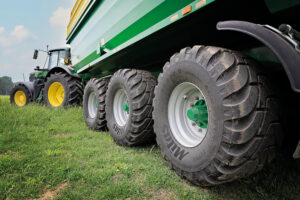
When looking at trailer tyres, Tom explains that Michelin again offers VF technology across its Trailxbib series. “We’re seeing more customers look for larger tyres on their tandem- and tri-axle trailers, up to 26.5in, and pay close attention to the speed rating of these to minimise the time spent on the road.”
As an example, he says a VF600/55R 26.5in tyre, with a load of 3t, can run at 17psi to minimise compaction in the field and still travel at 65kph on the road. As VF is not unique to Michelin, with nearly every major tyre company offering the technology, regardless of price point, he also highlights how Michelin tyres differ.
“A lot of competitors will achieve that 40% load-carrying increase, or 40% reduction in pressure, by making the
carcass stiffer, which creates stress across the tread and uneven wear,” he says. “Ultraflex is achieved through new
compounds and adjusting the actual architecture of the casing, which allows it to flex and spread out across a much wider footprint. This is without significant differences in wear and minimises soil damage.”
He adds that the tyres are designed to dissipate heat, which he believes will be a bigger concern going forward. “Heat increases tyre pressure and can cause blowouts when travelling at speed. You still see some trailers running on cross-ply instead of radial – which all of our trailer tyres are – and with the increased heat, road distances and capacities, this can cause a lot of problems.”
Front to back
BKT has a comprehensive range of tyres for the harvest season. Starting at the front of the combine, Willem-Jan
Straatman, product manager, agriculture division, says the company offers three ranges: the Agrimax RT 600 standard radial tyre, the Agrimax Teris with CFO technology, and the flagship Agrimax ProHarvest, which features CFO and VF technology.
“One of the key benefits of our Agrimax ProHarvest range is that we use polyester instead of nylon in the carcass, along with three steel belts,” he says. “Polyester doesn’t stretch like nylon, which means the tyre is much more stable at low pressures, and quickly returns to its shape when the pressure is increased. The steel belts then spread the weight evenly across the full footprint.”
He adds that it has taken time for customers to recognise how important the choice of tyres on the steering axle of the combine is. While some products have VF or CFO technology, the bulk of steering axle tyres are from the RM 500 standard radial range. “The market is changing, but the focus is nearly always on the drive axle of the combine. The steering axle, and the tyres on the trailer, are often overlooked.”
 Trailing compaction
The issue with overlooking the steering axle and the trailer tyres is that it can undo a lot of the good, Willem explains.
“You have big VF tyres or tracks on the front of the combine and VF tyres on the tractor, all running at low pressures, but then you run standard tyres at 3-4bar on the rear of the combine and on the trailers. We’re at the point where these cause the most compaction in the field.”
The vast majority of grain trailers still run on 22.5in tyres and Willem says the easiest solution would be to swap these out for VF tyres. Another possibility is to simply increase the size of tyre, which will bring several benefits.
“A 22.5in standard tyre will need about 3bar to carry the load in an 18t trailer, increasing to 4bar if it is not a steered axle. Increasing to 26.5in, this would drop to 2bar on a steered axle, with reserve for overloading,” he says. “This will save fuel and reduce compaction, giving a very good return on investment despite the increased
purchase price. Some are even moving up to 30.5in, or VF where the benefits are more pronounced.”
Leading the way
Alliance Tire Group has a history of innovation when it comes to trailer tyres. The company introduced the first flotation tyres with VF technology a decade ago, enabling pressures to be dropped from about 5bar to 3.2bar, while retaining a load per tyre of 5,300kg.
“The trailers are now doing a lot of the compaction damage,” explains Gerrit Vinkers, field service manager. “You have a tractor with VF tyres and central tyre inflation systems, and then 18t on the trailer on standard tyres, on a fixed tandem axle and leaf spring suspension.”
He highlights the UK, France and southern Europe as being behind much of the rest of the continent because of the smaller number of steered axle trailers on the road, and the fact that 22.5in tyres remain the standard. While larger tyres (26.5in or 30.5in) would help spread the footprint and increase the load capacity, Gerrit notes that one of the major issues is the fixed axles.
“If you’re working with a tandem fixed axle, this significantly reduces the total carrying capacity of the tyres,” he says. “Instead of dividing the weight by four, you should divide by three to take into account the dragging effect during turning because they do not follow true. This is without mentioning the additional cost of tyre wear it causes.”
This means it may be unsafe to use the full capacity of the trailer, as each tyre would technically be overloaded. This is compounded when travelling at speed.
“If you look at European manufacturers such as Krone or Joskin, they are specifically designing their trailers and
spreaders to accommodate larger tyres and steering axles.”
 Upgrading the combine
Like other commentators, Gerrit agrees that much of the focus is on the drive axle of combine harvesters. Alliance offers various ranges, starting with the 376 Multi-Star. This standard-technology tyre has rounded shoulders, meaning the profile will not cut into the soil during harvesting. There is also the 375 range, again with standard technology and a comparable load capacity (6,300kg at 3.2bar), but with a sharper shoulder to improve traction in difficult conditions.
The remaining products include the Agriflex, Agriflex+ 372 and Agriflex+ 377. These are differentiated by the inclusion of VF and CFO technology. “The 372 will be known from our large tractor portfolio, but the 377 is for the largest-capacity machines, including the New Holland CR11,” Gerrits says.
He compares the rear axle of the combine to the trailer tyres, in that they are creating compaction by following the larger VF tyres ahead of them. “The rear axle of the combine carries the weight of the engine and a proportion of the grain weight, so if you’re not using VF technology, you need to be running at a high pressure, which puts all that weight into a very narrow footprint.”
Protecting tyres
A recent development for the Mitas range of harvest tyres includes StubBlock; a new anti-stubble rubber compound for the HC3000 tyre range. Launched at Agritechnica 2025, the company says it is engineered to increase resistance to cuts, punctures and wear caused by crop residues.
The HC3000 also features VF and CFO technology, enabling growers to limit compaction when working in the field. From Trelleborg, sister company to Mitas, now both part of Yokohama, the TM3000 also uses VF and CFO technology, and the company says it has an advanced carcass design, enabling flotation, stability and soil protection.
It also offers the TM2000, with both ranges having a broad selection of tyre sizes that enable them to be used across combines and grain carts. This provides users with comparable technology across the full harvest cycle, ensuring that compaction is not caused at any step of the process.
“The TM2000 combines traction performance with resistance to impacts on uneven terrain, thanks to its flexible
radial carcass and deep lugs. In addition, the tyre ensures excellent lateral stability and operator comfort, even on rough terrain and during long working hours.
“Compared to a premium competitor, the TM2000 also demonstrated a significantly higher lug footprint index,” explains Roberta D’Agnano, Mitas global marketing director.
Buying new
Noting that most combine tyres are chosen when the farmer or contractor is configuring their combine harvester,
Roberta highlights four areas growers should focus on:
 Load capacity: Ensure the combine and trailer tyres are suitable for the load that will be carried
- Minimising soil compaction: Ensure the tyres will continue to carry the required load at a reduced pressure, and that VF and CFO technologies are available
- Durability: Ensure the tyre is specified to deal with high levels of heat and potential wear caused by soil conditions and residues
- Operation efficiency: The combination of factors will ensure continuous operation at the peak of the season.
“We design harvest tyres not as isolated products, but as part of a complete system supporting productivity, soil protection and long-term farm sustainability,” Roberta adds.
A clear shift
A spokesperson for Ceat notes the clear shift towards ‘premium, application- specific tyres’ that balance efficiency and soil protection. The company adds that its own development represents this.
“For combines, Yieldmax offers an ideal balance of traction, stability and load handling – ensuring smooth field
operations, even under heavy grain loads. Taking it a step further, Yieldmax VFLEX incorporates advanced VF technology, enabling farmers to carry higher loads at lower inflation pressures, which is particularly important for today’s high-capacity harvesters.”
The VLEX range is also available for grain carts and larger trailers, along with the IFLEX range, which are designed to provide a wider footprint and protect the soil during transport.
When it comes to ensuring that these tyres continue operating as expected throughout the season, Ceat recommends a series of basic checks. These include: ensuring the pressures match the task and load, inspections for cuts or stubble damage, monitoring of wear patterns, as uneven wear can indicate other issues, and removing stones and debris where possible to maintain traction.