


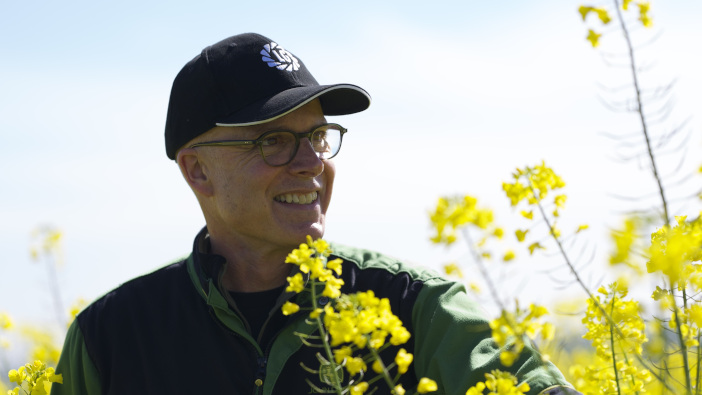
Paul Rogers, who farms in North Yorkshire, is reporting one of his best-ever oilseed rape harvests, achieving over 5t/ha across a 43ha plot.
He explains that the continuing progress in plant breeding is a key reason why he’s kept the crop in the rotation for 25 years. He adds that his management of the crop ensures that he gets the best from those improved genetics.
“You have to be led by the conditions, and moisture in the seedbed with relatively early drilling are amongst the most critical factors,” he says. “We grow a hybrid variety, because it has the vigour to get up and out of the ground and establish quickly, which we find is the best way to combat flea beetle.”
He uses the LG Adapt variety, which ranks highly for yield and oil content, with traits including pod shatter resistance, strong stem health and resistance to phoma and turnip yellows.
This year the crop followed spring barley, with the bulk being sown on the 9th of August, with 9ha sown three weeks later. Harvesting took place on the 23rd of July.
“We have an air seeder mounted on our Vaderstad TopDown, with a roller directly behind that helps to keep the moisture in the seedbed,” he explains. “It’s not as precise as some sowing methods, but has proven to be effective over the years.”
The land has benefitted from plenty of manure in the past, so fertiliser inputs were modest with seedbed nitrogen at 75 units/ha and a 0:20:30 PK compound applied at around 115kg/ha.
“The main crop grew away really quickly, and we were concerned it might have become too big, but it sorted itself out,” Paul says. “The later drilled field was affected by flea beetle, so we had to spray it three times, but it came through alright.
“By the spring we could see that the crop had real potential. We sprayed against Sclerotinia, and top-dressed with fertiliser in early March.”
“We’re very happy overall,” he concludes. “We stick to a tried and trusted method, and have great faith in the plant breeding programme, which continues to offer resilient varieties.”