


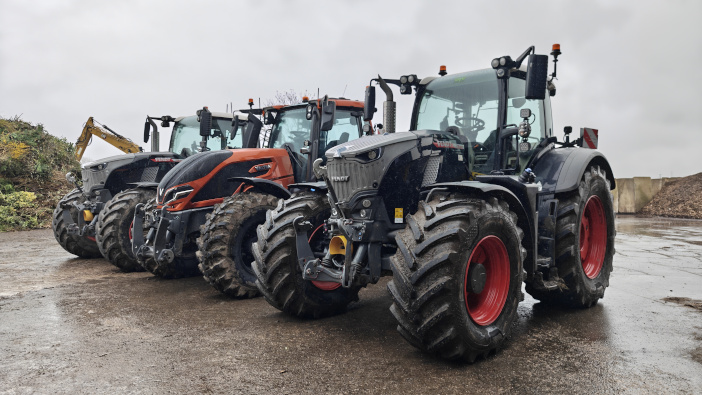
At Olly Harrison’s farm, near Prescot, Alliance discussed its new products and held a series of tests to showcase the potential benefits of different models across its portfolio.
The day started with discussions of the company’s new Agri Nova R-1 bias tyre. The choice to introduce a bias tyre, when the vast majority of the market has shifted to radial, might seem like a strange one; however, Michael Flensborg, country manager, Nordics & UK, said the UK market was estimated to be between 25,000 and 30,000 units – a large amount of potential sales for an underdeveloped type of tyre.
Speaking to Gerrit Vinkers, field service manager, we tried to discern exactly who these tyres would be marketed to. Those with classic tractors would likely consider the design too modern, and even larger operators purchasing second-hand machines would be unlikely to choose a two-wheel drive model. We put forward ploughmen and women taking part in match ploughing.
“That’s certainly a potential sales area,” he says. “There are still a lot of older tractors operating on farms, and young farmers willing to put the work in to refurbish these. By introducing a modern bias tyre, we can help them improve operation in the field at a lower price point than switching to radials.”
Modernising a classic
Girish Kumar Patidar, country manager, Ireland, said that there was a need to modernise the bias tyre and that no other company was paying attention to this market. Compared to previous generations of bias tyres from the company, this offers a higher lug count, with a new tread design, with each lug segmented with three angles.
This is said to increase traction in the field, while the additional rubber increases comfort on the road. A central tie bar and mud breakers around the tread help with self-cleaning properties, while the square profile and increased tread width spread weight and minimise soil compaction.
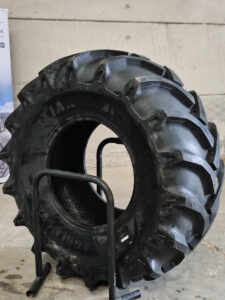 The Agri Nova is initially available in 60 sizes between 12in and 42in, with more in development. It is offered with a seven-year warranty.
Benefits across the range
The rest of the day was dedicated to various trials showing the differences and individual benefits of Y-AGT’s Agri Star II and Agriflex+ radial tyres. The first tests, on road comfort and fuel economy, were not done on the day; instead, Gerrit and Frederik Zandman, field service engineer, gave a presentation on the results.
The test used Olly’s two Fendt 728 Vario tractors and his Valtra Q265. The Fendts were shod with Agri Star II and Agriflex+ 372 VF tyres respectively, while the Valtra had Agriflex+ 373 VFs fitted. Each tractor was taken on a 17.1km course, travelling at a maximum speed of 50kph, including rural roads, A-roads and dual carriageways, with a Richard Western SRT20 tandem axle trailer, with 560/60R 22.5 tyres inflated to five bar and loaded to 18,340kg. Each tractor completed the course twice, with the tyres running at different inflation pressures.
Looking at the non-VF Agri Star II tyres first. When running at 24psi at the front and 35psi at the back, the tractor used 10.3 litres of fuel on the run, increasing to 11.9 litres when the pressures were dropped to 17psi and 20psi. Running on the road at a higher pressure resulted in a 1.6-litre saving, which, when extrapolated across the day, was estimated to save around £42.
The higher pressures also resulted in lower noise levels, both in the cab and for passersby. These were recorded at 77.3Db inside and 90.6Db outside, compared to 80.9 and 91.7Db at the lower pressures. However, the operator noted that driving comfort was impacted by the higher pressures due to feeling the tyres skip from lug to lug, as well as handling on straights.
The second Fendt 728 with Agriflex+ 372 VFs, saw similar results. Running at 40psi and 38psi on the first run, it used 10.6 litres, increasing to 11.7 litres when the pressures were dropped to 12psi at the front and rear. This was an estimated cost saving of £29 when spread across a full day of road work. Noise levels also followed a similar pattern, with 88.1dB recorded outside and 73.7dB recorded inside at the higher pressures, increasing to 90.9 and 76.9 at the lower pressures.
Interestingly, the operator noted a higher driving comfort at the higher pressures. Frederik noted that this was because of the rolling feeling caused by taking corners at relatively high speeds when pressures are low. The overall differences between the pressures were less pronounced on the VF tyre.
Variables
The Valtra Q265 presents a bit of a problem with the figures. While efforts have been made to make the tests as fair as possible, the different tractors do impact things. The Fendt has a 280hp rated output, 296hp maximum, and torque levels of 1,450Nm, not to mention the Fendt iD system that lowers the overall engine speed. The Valtra has a rated horsepower of 265, boosting to 290hp, and 1,200Nm of torque. Despite having the same operator, this would change the driving characteristics.
Not only that, the Fendt has a base weight of 9,650kg, compared to the Valtra’s 9,200kg. With ballast, the tractors were weighted to 13,080kg on the Fendts and 13,380kg on the Valtra. This creates a variance between the train weights during the test, totalling 31,420kg for the Fendts and increasing slightly to 31,720kg for the Valtra.
Not huge numbers, possibly not even enough to impact the results, but worth noting that this couldn’t be an exact like-for-like test.
The Valtra also ran three times. First at 35 and 40psi, then at 12psi front and rear, and finally at 17 and 20psi. The highest pressure saw a fuel consumption of 12 litres, while the lowest pressure increased this to 15 litres. The middle run used 13 litres. When comparing the highest and lowest, the approximate saving across the day was £79. This decreased to £53 saved when running at the middle pressures.
More interesting is that the hybrid lug design of the Agriflex+ 373 VF seemed to provide lower noise levels at lower inflation pressures. At the highest, the in-cab noise level was 78.7dB, decreasing to 77.1 at the middle pressures and 75.7 at the lowest. Only driving comfort reportedly suffered when switching between the highest and lowest pressures, but this was negligible. For the middle pressures, the tractor reportedly handled at its optimal, and noise perception was significantly decreased.
According to Frederik, this highlighted the need for compromise when choosing tyre pressures, especially when tractors are not fitted with central tyre inflation systems. “The lug design on the Agriflex+ 373 VF is designed for a mix of road and field work, so these are ideally suited to finding a suitable inflation for both conditions.”
 Pulling power
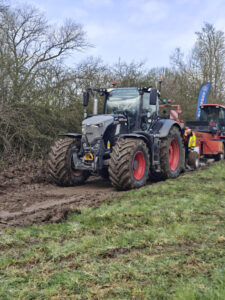
The final test was done on the day to show how each of the three tyres (inflated to 14psi) responds to muddy conditions. Pulling a sled used for tractor pulling, each of the machines travelled along a dug-out track in the field to show how the tyres filled up and subsequently cleaned themselves, and the traction and slippage.
Again, we had the same variables seen with the road tests, and an additional run with the Agri Star II tyres. The reasons behind this were that the Agri Stars were running in the initial muddy layer on the track, where traction was an issue – subsequently, it did not pull as far as the others. There is an argument that farmers and contractors rarely repeatedly drive over the same area in wet conditions, so the first run was the most accurate to real-world conditions.
As such, this test didn’t really prove a lot. The Agri Stars filled up on the first run and struggled, but each subsequent pass saw every tractor reach the end of the run, with less mud accumulating on each tyre. It showed that the Agriflex+ 373 VF segmented tread could perform well in field conditions, matching the more traditional tread pattern of the Agriflex+ 372 VF, as well as highlighting the Agri Star II’s ability to run at a reduced pressure underload despite not being a VF product.