


For farm businesses looking for a viable vehicle to move staff and equipment around, or to tow trailers, the change in classification of double-cab pick-ups from April 2025 will have made many think twice. The increased costs of running a double cab through a business are high, and while single cab and extended cab vehicles still exceed the 1t payload threshold, these are not without their own compromises.
Then there’s the fuel. While globally some electric vehicle markets were in decline, nearly a quarter of the 2m+ cars sold in the UK in 2025 were electric, and while the prospect of the pay-per-mile tax coming into force in April 2028 may put some off, for an average mileage of 10,000 miles per annum, this comes out at £300 a year for fully electric vehicles. And farms are in a better position than most to significantly cut fuel costs by producing their own energy, either through anaerobic digesters, solar panels or wind turbines.
Of course, the benefits are quickly outweighed if those vehicles are unable to meet the requirements of the user. So, it was with great interest that we headed down to Sussex in the middle of December to put a new range of Kia EVs through their paces.
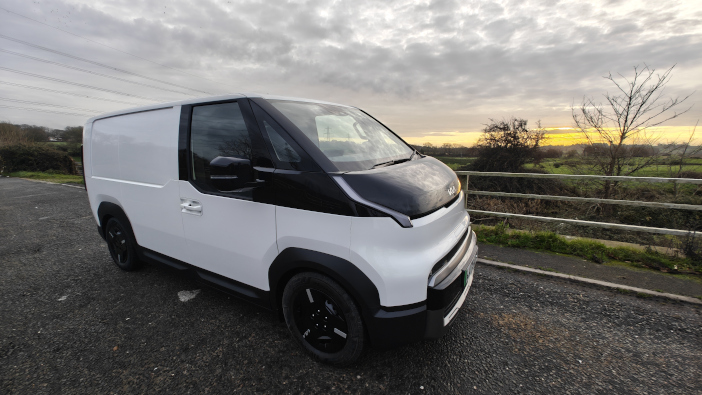
PV5 Cargo
The company’s first all-electric light commercial vehicle, the PV5 Cargo, comes with the choice of a 51.5kWh or 71.2kWh battery pack, the latter of which offers a possible range of 258 miles. Both of capable of fast charging, with max speeds of 150kW to top up from 10% to 80% battery in less than 30min.
If we look at the practical aspects first, the cargo bay has a volume of 4.4cu m, with dual rear doors as standard and the option of a side door. It’s spacious, with plenty of room for tools thanks to the 2,255mm length and 1,565mm width, dropping to 1,330mm between the wheel arches. The payload might not break any records, with a maximum of 790kg with the standard battery pack, going as low as 665kg when the long-range battery is mounted, and side doors are optioned, but this can be supplemented with a braked towing capacity of 750kg.
How this would impact the range of the battery isn’t 100% clear. On our test, we travelled with 350kg in the hold and didn’t see a noticeable decrease in the maximum range – we were the first in the machine on the day, so we were starting at full charge. However, this would need to be taken into consideration.
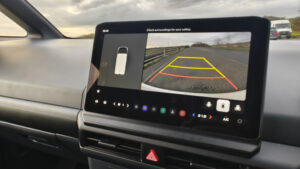 Jumping into the cab and while the overall design is practical, and perhaps a little sparse, the PV5 is hiding a lot of nice features and nice-to-haves. Many of the systems have been brought over from the company’s family car and wider EV portfolio. It uses an Android-style functionality within the 12.9in navigation screen, which enables fleet management apps to be installed where required. It can also quickly link to a smartphone for quick personalisation of the mapping app and entertainment systems.
The digital dash is smaller and isn’t fully integrated in the way you might see in a typical Kia, but it is functional and gives a clear indication of charge, potential range and speed, as well as any driver assistance functions which are activated. On this note, the PV5 has a full range of systems integrated, including intelligent cruise control, lane assist, and three driving modes, including eco, normal and snow.
The driving experience was good. The PV5 feels compact, even when travelling through a small and busy town like Battle. Given the way in which electric vehicles work, I don’t have to explain that it pulls away very quickly and can rapidly get up to speed when getting on dual carriageways. The only complaint would be that visibility is poor to the right-hand side of the driver, despite the large mirrors, making some junctions tricky when trying to see oncoming traffic.
Product manager Dave Catt explained that the instant torque provided by an electric drivetrain is one of the reasons Kia believes it could find a spot on some farms. “If you’re taking this into a field and conditions are wet, you can feather the accelerator to maximise the use of that power without wheel spinning.” While we weren’t given a chance to get the vehicle muddy in a field, there’s little reason to doubt the theory; however, the PV5 is currently only available with front wheel drive, so how this would hold up in practice, especially with a fully loaded cargo bay and maybe even a trailer, is yet to be seen.
Another concern is the ground clearance, which is just 147mm. While this provides a low entryway into the rear of the vehicle, it runs the risk of bellying when travelling over a rutted bridleway or quickly getting bogged down in a wet field.
Despite new variants of the PV5 Cargo due to come out later this year, including a crew cab and chassis version, the latter offering a payload of 700kg, both of which could be more suited design-wise to ag, there are no plans to increase the ground clearance or add an all-wheel drive function.
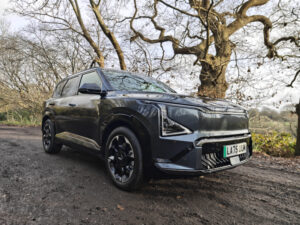 EV5 – the electric Sportage
To be honest, the standout farm vehicle at the Kia event wasn’t the main focus. Alongside the Passenger and Cargo variants of the PV5, we had the opportunity to test drive the EV5 – essentially the company’s Sportage model with an electric driveline. This not only boosts the ground clearance to 167mm, a full 20mm over the PV5 Cargo, but has a towing capacity of 1,200kg and is due to receive an all-wheel drive variant later this year.
Not only does it bring with it these practical benefits, but honestly, it’s a nicer drive. The Cargo sacrifices a few elements due to the type of vehicle it is, whereas the EV5 brings with it a lot of creature comforts and has an extended range of up to 329 miles, with the same 10-80% charging in under 30min on average.
While it lacks the space for any large amount of tools, being a family-style SUV, it does have plenty of boot space and enough space for four people to sit comfortably. Depending on the trim you opt for, it can be fully specified with a suite of driver assistance and infotainment systems.
Getting behind the wheel and it offers a really smooth ride, with clear and intuitive controls of things like cruise control. It feels practical and robust enough to traverse fields and farm tracks, but with enough comfort and range to function as a general farm vehicle – handling those drives into town, or to Lamma and Cereals.
Does Kia have an EV for UK farms?
Obviously, the number of variables makes selecting a vehicle tricky – the capacity of the PV5 Cargo will make it a more suitable choice for those regularly transporting tools to and from the field, or who have perhaps diversified into direct-to-consumer sales. Similarly, the people carrier variant, the PV5 Passenger, could find favour amongst larger vegetable growers who need to transport people back and forth.
On the other hand, the EV5 offers more comfort, greater range and improvements to the trailer capacity and ground clearance that arguably make it more suitable for tackling the difficult ground conditions that a farm vehicle may have to traverse, while still being comfortable enough to travel further afield.
The light commercial vehicle range feels like a strong entry point into an existing market, but one that doesn’t have the specific niche of agriculture in mind. Farmers have a lot of opportunities to capitalise on electric vehicles, but for ag-specific performance may need to look elsewhere.