


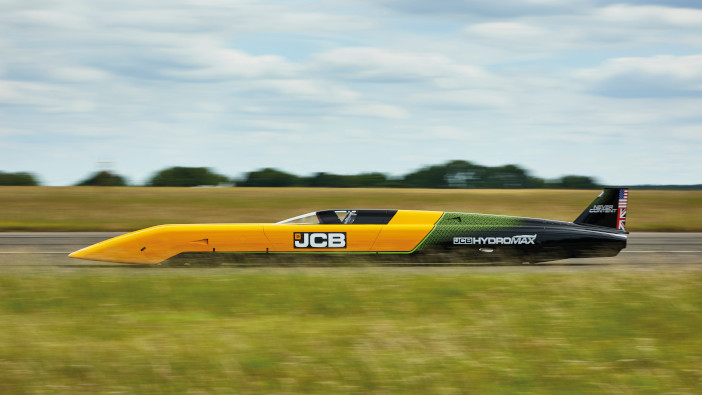
JCB is aiming to achieve a hydrogen land speed record to help highlight the fuel’s potential.
Some might view our trip to see JCB testing its HydroMax car at RAF Wittering as more of a jolly. What does it even have to do with agriculture?
The car is being tested to take a crack at the hydrogen-powered land speed record as part of Speedweek at the Bonneville Salt Flats in north-western Utah. It comes 20 years after JCB set a diesel speed record with its DieselMax car. But it does have a serious message. As part of its ‘Off-road to zero’ project, the company wants to meet net-zero targets by 2050.
Since 2010, it has reduced carbon dioxide emissions per machine by 60%. But to achieve the net-zero target, it has to go further, which means it needs to look at alternatives to carbon-based fuels.
JCB has evaluated a number of options. The future is probably a combination of electric and hydrogen, or a hybrid. But for its larger off-road equipment, which includes the Fastrac, the goal is finding a fuel source that maintains machine performance and meets customer expectations.
Electric power
For its compact range, electric power is viable –JCB now offers 22 models over nine product ranges. Its compact range is often working at sites with access to the grid. The problem is that it’s a small part of the JCB portfolio, and the majority of sites where JCB machines work are remote.
“If we make all of our compact models electric; some 15% of our sales; we only reduce our emissions by 5%,” says JCB advanced projects development manager Tom Beamish.
There are also weight and package limitations. In the car world, swapping an engine for a heavier and bigger battery cell is more straightforward. But a 1.9t excavator has to remain just that, and many are designed to go through a standard door.
JCB also investigated connecting to the grid. It looked at connecting one of its quarry testing sites, where diesel
generators charged electric vehicles. However, with cabling tunnelling costs of £1m/mile, it isn’t viable. Nor was taking generators to the grid, as traffic problems or adverse weather could stop or delay the journey, leaving an uncharged machine idle. Of course, the other problem is that many JCB customers are always moving from site to site.
Mobility is key
Although electricity generation is easy with solar and wind technology, moving it around isn’t. To ensure machine uptime, JCB realised that fuel mobility and quick refuelling are essential. That is why the company is betting on hydrogen and why we went to RAF Wittering – the HydroMax car is part of the proving process.
Running the HydroMax at high speed down the Bonneville Salt Flats is designed to demonstrate the power and potential hydrogen engine technology offers.
The problem with plant and machinery is the engine load. Digging a hole or pulling a grain trailer requires plenty of power and machinery can go from idle to full load very quickly. The obvious answer would appear to be biodiesel and hydrotreated vegetable oil (HVO), but Tom points out some snags.
“What comes out of the tailpipe is the same; the carbon dioxide savings are in fuel production, not the operation. We needed something cleaner to meet net-zero targets.”
There are also concerns over just how sustainable some HVO sources are. HVO is widely used today, with most imported into the UK. However, some Asian countries appear reluctant to open their doors to verification.
 The case for hydrogen combustion
Hydrogen engines are not new; the technology has been around for years. Indeed, Isaac de Rivaz developed a
hydrogen engine as early as 1806.
Why diesel has remained the dominant power source for plant and machinery is because of brake thermal efficiency (BTE), or put more simply, the percentage of fuel energy that goes into powering the
flywheel.
“Getting hydrogen engines to run isn’t the problem, getting them to run well is,” says JCB principal engineer Mark
Richard.
Essentially, a hydrogen engine is not greatly different to a diesel one. Diesel engines compress air to heat it and then inject fuel into the cylinder head, where it atomises and burns. Hydrogen is an energy-dense fuel; 1kg of hydrogen gas has the same energy capacity as three litres of diesel. But hydrogen is readily combustible and early engines burned the fuel too quickly, producing high temperatures and reducing efficiency. Although it was cleaner, hydrogen’s BTE was significantly below that of diesel.
As improvements in modelling and computational fluid dynamics were made, it allowed the JCB team to refine the mixing of fuel and air, and how it is delivered into the cylinder, helping to overcome the power issue.
Using diesel technology
Fortunately, JCB hasn’t had to do too much else to turn its diesel engines into hydrogen. The block and cylinder head are the same, and JCB has retained the turbo from its diesel engines to squeeze more air into the engine. It even employs the same pushrod valve opening mechanism.
Hydrogen has a lower density than diesel, which can be injected at lower
pressure. Injecting fuel into the intake manifold rather than the cylinder means the fuel and air mix better, offering a more efficient combustion process.
The other refinements include swapping the injector for modified spark plugs and a specialist oil to help capture the water created through the combustion process, which is then boiled as the engine heats up.
Not only has this delivered better BTE than a diesel engine, it also doesn’t require after-treatments such as a diesel oxidation catalyst, diesel particulate filter and selective catalytic reduction to meet strict European emission limits.
Using the same four-cylinder, 4.8-litre engine has advantages for JCB. It means only minor changes to the assembly line and the same large displacement and rotational mass of its diesel equivalent.
“You need the rotational mass of the flywheel, as sudden changes in load would cause it to stall,” Mark adds.
With 50,000 hours of testing, hydrogen has proved just as reliable as diesel, and the feedback from operators who have tested gas alternatives is positive, especially in terms of the similarity between the hydrogen and diesel models in terms of refuelling and servicing.
The land speed car
Coming back to the HydroMax car, Mark explains that JCB is using the same four-cylinder, 4.8-litre engine as its diggers, with some adaptations.
Some components are the same, such as the block, crankshaft and clutch. But to turn a 74hp engine into an 800hp one means several ‘refinements’ are needed.
To keep the engines cool, seven litres of engine oil are filtered every seven seconds. Ice tanks sit close to the front and rear engines to help cool them. Every run will use 250kg of ice (producing and storing ice in the desert also present a challenge). Close to 1km of wiring runs through the car and the engines have to be perfectly synchronised.
The fuel flow has increased from 4kg/hour to 50kg/hour, as has the pressure, with the fuel rail operating at 50 bar. That is to get the maximum amount of fuel in with a narrow valve opening window of an engine running at close to 4,000rpm.
 JCB has moved to double overhead camshafts to offer more precise valve opening timing.
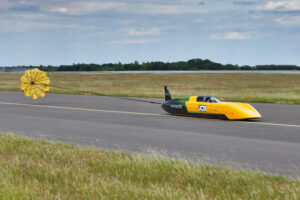
To stop the machine, friction brakes based on an ATR 72 aircraft are required in case both parachutes fail. Similar to a multiplate clutch, it provides the surface area to dissipate the heat.
The body is based on the DieselMax but is even sleeker. With more advanced modelling technology available, a more ‘chiselled’ front end and a narrower rear have given a 10% aerodynamic improvement.
NACA air intake ducts are responsible for 4% of this alone, and with the help of two titanium turbo compressors, pump the equivalent of a standard bathtub of air every half-second.
Ground clearance
The car also has greater ground clearance, as the tyres expand as they heat up. As they do so, it changes the gear ratios, effectively providing an additional gear.
This is needed to get the car to go faster, as well as helping it to reach its maximum speed earlier, because the Bonneville Salt Flats have deteriorated in recent years, reducing the track length.
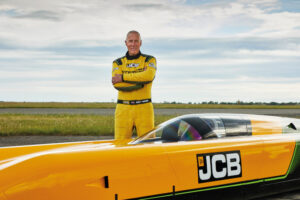
Across two days of testing, with Wing Commander Andy Green OBE behind the wheel, the HydroMax achieved 208mph – an increase on the 177mph achieved earlier in the programme. It’s still a little way off the 350.092mph achieved by the DieselMax, which the company aims to beat, but JCB believes it is a promising start to its campaign.
