


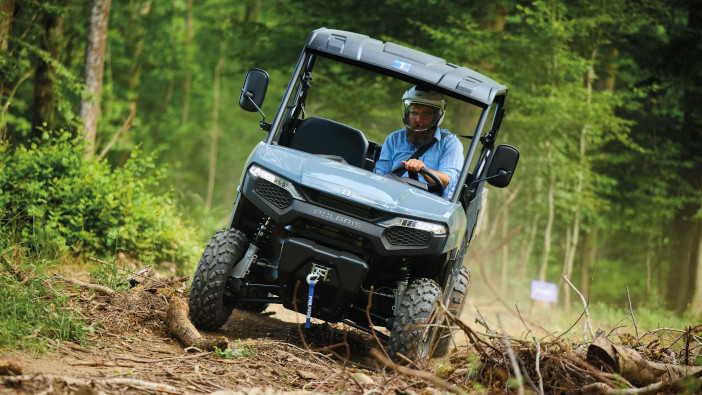
The off-road brand hopes its new Ranger 500 will fight off some of the cheap imports coming to Europe. We headed to France to get behind the wheel.
Polaris says it has typically targeted the mid- and high-end ranges of the UTV market with its products. With the Ranger 500, which is making its way into Europe after being launched in the US last year, the company hopes to gain ground among cost-conscious customers tempted by imported brands.
According to Jenika Bishop, global marketing manager, this has been successful so far. “Of the customers in the US who have purchased a Ranger 500, 67% have been new to Polaris.”
While it is certainly targeting the budget end of the market, the company does not appear to have scrimped with the build of the machine. In fact, its specification sits so closely to the base-level Ranger 570 that you can’t help but wonder if some customers will opt for this new model, priced at just £9,999.
“There will likely be some cannibalism of our 570 market,” says Jim Clarke, regional director for central Europe and EMEA. “But we will also see some traditional ATV customers make the move to the Ranger 500 because of the price point and the improved safety and comfort of a UTV.”
The machine is powered by a ProStar 567cc engine. Interestingly, while this has been downgraded for the US market to 28hp, international customers, including Europe and the UK, will get the full 48hp to play with. This is put to the ground through an in-house, two-range continuously variable transmission, offering top speeds of about 33kph in low and 60kph in high range.
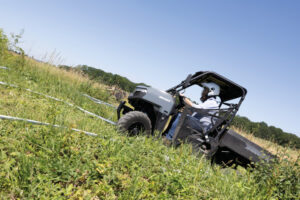 It comes with a roof as standard, with the option of front windscreen and rear panel, and has a steel front bumper with an integrated 1,134kg-capacity winch. In what sounds like a simple change to implement, the bumper extends beyond the front tyres, so if you do come into contact with something, the tyres will not take the brunt of the impact.
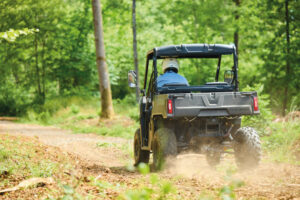
Towing capacity is 680kg, in line with the pricier models in the range, and 227kg capacity in the rear deck. Using a
gas-assisted strut, the rear deck tips to make unloading easier.
At just 1.5m wide, it is compact enough to squeeze through tight gateways and down bridgeways or traditional buildings, but this doesn’t equate to a cramped interior. In fact, there was ample room in the cab, with plenty of recessed areas to store tools, or your lunch. You can also lift the passenger seat and store equipment in the belly of the Ranger 500, although the driveline is exposed under there, so anything that could wrap around the shaft, or shift during transit should probably be kept elsewhere.
Steady as she goes
The Ranger 500 won’t win any races. It is steady on the acceleration, reaching top speed eventually. There is no shift-on-the-fly here, so any desire to move up from low range to high requires you to come to a complete stop, but none of these are necessarily bad features.
The steady acceleration and overall stiffness of the pedal means it is easy to maintain a set speed if the Ranger is being used for application tasks. While simplifying the driveline, Polaris has also added automatic locking at the front axle, which means the unit will shift in four-wheel drive when in difficult terrain without operator input. In addition to this, the VersaTrac turf mode has been retained, making it suitable for turf and other delicate surfaces.
Taking it around the course at the Hectar agricultural school at Levis-Saint-Nom, we were impressed with the overall comfort of the machine. While the ongoing heatwave meant traction was never going to be an issue, the rock-solid ground was unforgiving when it came to bumps and dips in the road, but the front and rear suspension on the Ranger dampened these effectively.
The steering feels stiff at first, and the turning circle isn’t ideal, but these are relatively minor complaints when it
comes to the driving experience. And the cost-cutting to get the machine to that sub-£10,000 price point only really shows in one area – the one-piece hood. Made from plastic, it’s flimsy and easily catches on the mirrors when opened.
It’s a surprisingly cheap-looking component on a UTV that exceeds expectations considering the price.
 Accessorising
Alongside the standard specification, there are some optional extras to boost the versatility. A plough mounting can be fitted at the front. We tested this on the day with gravel, for which the unit felt a little underpowered, but with snow or woodchip it could be a handy feature.
It is also possible to mount applicators and sprayers to the rear, with the boom mounted at the towbar and the tank sitting on the rear deck. These are just bolt-on features, making them easy to take on and off, and are directly powered, which means the engine rpm affects the application rate. It is perhaps not a choice for super-accurate tasks, but suitable for patch-spraying problem areas in the field.
You get a lot for your money with the Ranger 500 and, as Jenika puts it: “Customers benefit from our established dealer network and backup.”