


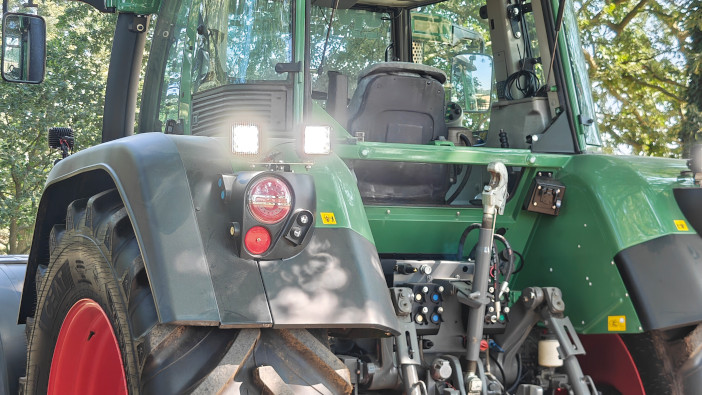
Capable of controlling up to 32 lights via Isobus or a dedicated smartphone app, Smart Lighting will reportedly improve safety and operator comfort.
The Smart Lighting project has been a long time coming, according to UTV Products managing director Ben Bonell.
“There are a lot of different directions we can take the technology in, and every new idea has added to the development process,” he says.
UTV Products is best known for its wide range of aftermarket LED lights, with plug-and-play models to suit most modern and classic tractors, as well as loading equipment, harvesters, sprayers, trailers and a host of implements. Each new model is developed and designed at the UK base near Nantwich and mounted into a casing built to the dimensions of the existing housings on each tractor.
Functionality
Smart Lighting is set to add greater functionality to these lights. Using control modules that are linked to either two, three or four lights – depending on the layout – the lights can be sequenced and adjusted via the mobile app, developed alongside local firm HG3.
“At the moment, lights are either on or off, but there are scenarios when this isn’t ideal,” explains Ben. “For example, if you are harvesting night, like some are having to do because of the heat, the operator can sometimes be blinded by the tractor lights. With Smart Lighting, you can adjust the intensity of the individual lights on a sliding scale from 0-100%.”
So, as the operator pulls alongside the harvester, the lights on that side of the tractor can be dimmed while the remaining lights remain at full brightness.
Another use is with verge mowing or hedgecutting during the winter. The dark nights mean operators may need the lights pointing towards the working area at full power, but with lights on the roadside dimmed to protect other drivers.
Scalable technology
With up to 32 lights available with the system, Ben says Smart Lighting can be adapted to suit any setup. The system uses the tractor’s wifi signal, which will be strong enough to maintain signal with lights at the back of a tri-axle trailer.
“If the signal is lost, the lights will remain in the same sequence until the operator can reconnect,” he adds.
It is also compatible with any of the UTV Products range. This means the system can be retrofitted if required, but, more importantly, users don’t need to purchase specific lights to gain access to the system.
It is easy to set up as well, with a quick identification process within the app that makes each light flash in turn. The position of each light is then saved and the desired sequences can be set.
The current software will enable the lights to be on, off, in strobe mode, have the brightness adjusted, and switch between the various light shades – white, orange and red – to suit the conditions.
Ben is excited about the further possibilities of the technology. This includes linking the system to Isobus, which means the light effects could be integrated into headland management sequences, or perhaps even guidance systems.
As a possible use case, operators could dim roadside lights when on the headlands or set rear working lights to turn on automatically when the implement is lowered.
In-cab control through Isobus would also eliminate the current limitation of the technology. As it uses the tractor’s wifi signal, if an operator has Smart Lighting on multiple machines in the fleet, they will have to connect and disconnect from each tractor to call up other lighting profiles.
A link-up with artificial intelligence-integrated camera systems could see further benefits. For construction operations, when the rear arm of a backhoe is turning, the camera will scan the arm’s radius for people or obstructions. This would then trigger the slewing motion to be slowed, and a dedicated LED to turn on and highlight the possible danger.
Similar systems could be integrated along sprayer booms, with the lights adjusting in brightness based on conditions to ensure spot-spraying cameras always have the best possible view of the crop.
Finding use cases
“To be honest, we have a lot of ideas of how the system can be used, but now we need to get it in the hands of customers,” Ben says. “The best way to find out where improvements can be made, or what would really help users, is to have Smart Lighting out in the field.”
GPS receiver tracking
While we were looking around the Smart Lighting system, UTV Products managing director Ben Bonell also showed us another prototype, developed alongside HG3, designed to notify users when GPS receivers are stolen and track the location of the units so the police can be informed.
A retrofit system, it has two GRSM modules and accelerometers installed in the receiver. When the machine is powered down, it will automatically create a geofence and if the receiver moves out of that area, the user will be notified by text with a Google Maps link to show the exact location.
“We tested it by driving into Wales and we had a constant stream of notifications as we headed towards Bangor with the receiver,” Ben says.
While it will not fit into all receivers due to the size of the components, and is only suitable for external models, the system could go some way to helping farmers retrieve stolen property. The battery is said to last a full week when not powered, which should be ample to track the unit to its final destination.