


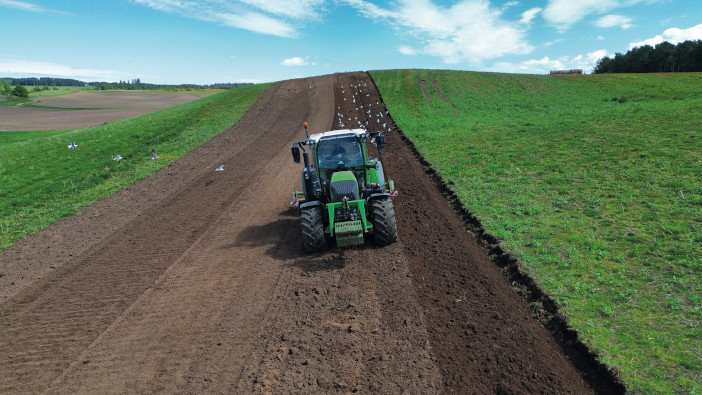
Choosing the tractors needed to revitalise a 10,000ha Scottish estate is an unenviable task, but for manager Billy Fotheringham the move to a leased Fendt fleet is working well.
Blackford Estates used to run five combine harvesters in the 1980s, but its productivity has since reduced significantly. The home of Highland Spring Water, the estate also has an 18-hole golf course, 3,000ha of ploughable ground and 5,000ha of grazing land, 1,000ha of woodland.
“The estate was essentially put to sleep, but in the last 15 years we have been gradually bringing it back to life. We are growing 200ha of combinable crops, 100ha of turnips and seed potatoes, 40ha of sheep keep and 60ha of fresh grass on rotation,” says Billy.
He concedes this is a fraction of what the land is capable of and that it would take years to see its full potential, if that is what the estate chooses to do.
“We have 1,500 ewes with the aim of increasing to 2,000, 220 Angus cattle and 120 Wagyu plus followers. The Wagyu bullocks are kept on farm for up to five years to improve the marbling of the meat and are housed all year round. Housing and feeding a controlled hay diet helps to keep the fat white,” he says. “It also takes a considerable silage effort to provide enough forage,” he adds.
Following various problems with tractors and unexpected bills, Billy chose to move the estate’s fleet to a rental contract with Fendt dealer Pyketts.
 “The hidden and unexpected costs associated with running tractors of different ages and brands was too unpredictable. Pyketts offered a premium tractor at an affordable fixed price which includes everything from oil to tyres. Each tractor is on a 1,000 hours per year contract and we get pretty close to that, so I have kept one or two other tractors in reserve but very soon we will have a fleet of five Fendt tractors,” he explains.
Many would expect these Fendts to be 700 series or possibly larger, but the most powerful in the fleet are two 516 Power Plus models. The four-litre, 163 hp, 6.4 tonne 516 is as powerful as it is nimble. A combination that, with its FendtONE operating system, Visio cab and impressive economy, made it the perfect fit for the estate.
“In many ways we benefit from the technology of the larger Fendts without having to shoulder the higher price and depreciation. We are lucky to have sandy soils that are easier to work and require less power. FendtONE is helping us to map the estate again and I am using it to create jobs for the operators to carry out. The GPS data comes from each job and that is helping us to map each field,” he says.
Using FendtONE he is also recording the time and fuel costs for different tasks as a way to set a benchmark.
“By having a fixed rental price and recording each operation, I can feedback to the estate the overall cost of our work. Regenerating land is not a quick or cheap job. We have spread 550 tonnes of lime already this year, and last year we made 3,000 bales of hay. We have also started planting our own cereals crops, although that is very small scale at the moment,” he says.
The data from the tractors shows that the 516 is light on fuel, using 12.3 litres an hour to plough using a four furrow, on land Pottinger, and just 4.2 litres an hour when applying fertiliser.
“With fuel at £1.20 a litre, having an economical fleet is saving us thousands over the year. With each tractor in a 1000-hour annual contract, the Fendts work out cheaper than some obvious competitor brands because the fuel economy is so much better,” he says.
The versatility of the 516 means its front PTO can accommodate a second mower and soon the estate will have both front and rear mowers to make full use of this. There are also plans to start investing in more arable equipment.
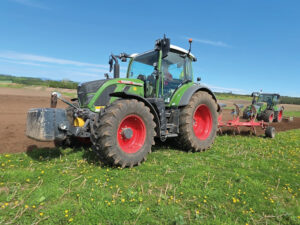 “We have an old drill that needs updating and various other bits of kit that could be replaced. So far, the 516 has proved itself more than capable of heavier work so we are going to try and get a sward lifter this year to alleviate some of the compaction caused by the cattle,” he says.
Working alongside the 516s are two 313 Vario models and another is due to arrive in 2026. The smaller 313s are on the same 1,000-hour-per-year rental agreement as the 516s and have been deployed to manage the estate’s grassland.
“The 313s do the silage prep work with the tedder and rake and run our balers. They can mow too, but the 516s are more capable. We have undulating ground and, even though it is a small tractor, there is no pull or push with the weight of the baler. We also use them for mucking out and hauling because they can pull upwards of 12 tonnes, which is impressive,” he explains.
The 313 generates 133 hp which, at a shade over five tonnes, gives it a similar balance of power to the 516.
“We have two fitted with loaders and use wheel weights along with sufficient ballast to enable them to do heavier work. The 313 is a really versatile tractor and, because it shares the same functions, controls and cab as other Fendts, you could be fooled into thinking it is a larger, more powerful tractor than it is,” says Billy.
His introduction to Fendt tractors came following a bad accident in 2005 which left him unable to operate his existing tractor.
“I changed to a Fendt because of the Vario and I had been told the seats were better. I had a whole day in one and felt fine. Since then, I have always seen Fendts as the most comfortable and easy to operate. Now that there are such good rental agreements to be had, it makes having Fendts cost-effective too,” he says.
The attraction of having such modern machinery without hidden costs gives him peace of mind while providing the estate’s operators with tractors that make their lives easier.
“If I sit down and do the figures, we are paying the depreciation and bit more but we are not shouldering the cost of the machine. 20 percent is lost year on year whatever you do. We don’t have to pay for servicing, tyres, oil or filters, which saves thousands too. But most of all there are no grey areas, it’s clean cut and the service from Pyketts is exactly what we need,” he says.
With uncertainty over how much land the estate will choose to cultivate, the Fendt fleet is a good fit for managing the grassland and livestock. Billy suggests that, with grain prices still low, it is unlikely that the estate will return to needing five combines.
“We don’t have the infrastructure anymore, and the investment needed, not just in tractors, would eclipse any potential profits for many years. We have built a good reputation for our Wagyu and Angus beef and that is our focus. However, with the new Fendts, we have proved we can diversify and make better use of the land we have available,” he concludes.