


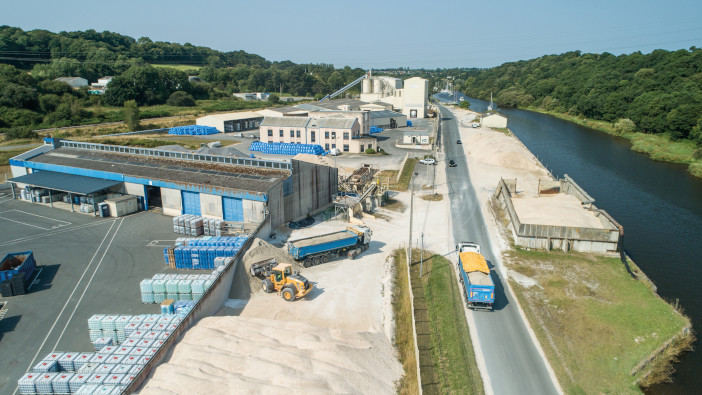
A trip to St Malo, Brittany, provided us with a glimpse of how the Timac Agro product range is developed and manufactured
The story of Timac Agro shows how circular trends within our industry are. Established in 1959 by Daniel Roullier, its first project was to process and commercialise the use of maerl – a naturally occurring algae that has historically been used as a fertiliser since the 1600s. Whereas farmers in Brittany had previously collected maerl and spread it on fields whole, the crushing and processing of the material meant that it was absorbed by the soil more quickly, releasing the calcium carbonate.
Out of this, the Timac Agro brand has grown, being the cornerstone of the Roullier Group, and while maerl dredging and use has become controversial because the slow, natural formation cannot keep pace with its removal, the use of algae as an alternative to commercial fertilisers is back in fashion.
The company has expanded significantly, with 83 industrial units in its portfolio, a specialist research centre in St Malo, various mines and a huge international workforce. More than 50% of the team are in-field product specialists, making regular visits to farms to discuss requirements and show how products could benefit different systems.
Centre Mondial de l’Innovation Roullier
Overlooking the original factory and St Malo port, the Centre Mondial de l’Innovation Roullier (CMI) is a specialist research centre designed to combine research and development with PhD-level agronomic research. That’s according to Eric Nguema-Ona, plant scientist and R&D project manager.
The centre has a full-time research staff of 78, and facilitates various projects both for internal use within Timac Agro and the wider Roullier Group, and in partnership with international centres. Eric says that having scientific work done alongside product development means that the whole process is done with a view to scalability and end users.
Increased regulation around maerl, and the protection of other species of algae, mean that a lot of work has been done to determine how the nutrients naturally form, as well as isolating and concentrating these molecules. This was the impetus for the company’s range of biostimulants, the first of which was launched in the late 90s when there was almost no regulatory control.
 Using natural resilience
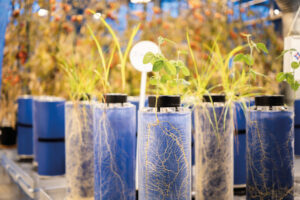
There are five greenhouses at the CMI, where the company conducts both non-invasive and invasive plant science to monitor the effect of products on different species of plants, and to see how naturally occurring traits form within a certain species, and how these can be used to boost growth and resilience in others.
Various chambers are fitted within the greenhouses, with different camera systems, including infrared and multi-spectral, and irrigation systems that can mimic drought and flood scenarios. Of the 75 different plant species at the CMI currently, Eric highlighted those known as resurrection plants. These can survive drought to the point of desiccation, before recovering when water is reintroduced.
The CMI has researched these in collaboration with Jill Farrant, professor of molecular and cell biology at the University of Cape Town, South Africa, and there could be clear benefits to crop variety development in a changing climate.
Making liquid fertiliser
As part of our visit, we travelled 130km to the company’s liquid fertiliser plant in Pontrieux. Initially established in 1957, it was acquired by Timac Agro in 1963 and has been expanded to include biostimulant production in 1991, and a full Agrotech workshop in 1994, which supplies all other Timac Agro factories with components for the company’s products.
It brings in raw soil conditioners, powdered products, plant extracts, seashells and up to 800 types of seaweed for the manufacturing process. Seaweed is sustainably sourced from the coast, with licences in place for extraction.
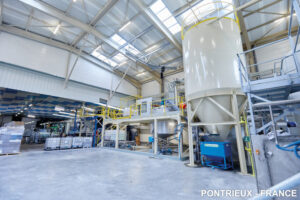 As well as manufacturing, the site also stores a proportion of raw material to monitor degradation. This enables Timac Agro to assess how long products will last once produced.
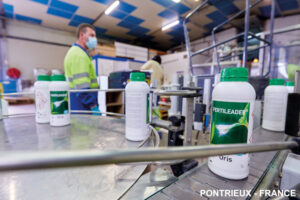
The production is fully automated, with recipes inputted and the raw materials kept in bunkers. Up to 30t can be produced each day, and packaged in bottles between 1-20 litres, or in IBCs for large-scale users. The first lot produced is kept on site to continue the lifecycle monitoring, while a second is taken for lab testing to ensure that the nutrient content is correct.
Testing is done at nearly every point of the process. Timac Agro can produce products with up to seven active ingredients, so testing is done to check the impact on pH and nitrogen. Additional experiments are done to test the compatibility with other products for tank-mixing, with around 8,000 results stored in a database.
Granular products
The bulk of Europe’s granular products from Timac Agro are produced at the company’s site at St Malo, positioned right at the harbour for easy shipment out of Brittany. Granules from 2mm up to 5mm are made, as well as microgranules and animal nutrition products. Around 500t/day can be made at full capacity.
Dry materials are brought in, weighed and then ground down before being added to a slurry with the wet ingredients. This is then dried and pelleted before being screened. Granules that do not meet the size specifications are reintroduced to the slurry and go through the pelleting process again.
The drying process, which is done at several points during manufacturing for consistency of ingredients, uses locally sourced wood in a biomass boiler, with filters in place to capture emissions, and the heat is transferred to be used at other points of the facility.
The site currently ships around 10,000t to the UK each year.
The biostimulant market
During our visit, we were given a talk by Dr Petros Sigalas, technical research and development advisor, about the role of biostimulants. Unlike other inputs, these are defined by function rather than composition, with each designed to improve one or more plant characteristics. The most common being stimulating nutrient use efficiency, which in turn boosts natural defences.
 He said that biostimulants can be split into microbial and non-microbial forms, with the former being a living organism that is applied, while the latter uses plant extracts and humic and amino acids. In the ten years since the CMI was established, Roullier Group has taken part in more than 80 collaborations, resulting in over 60 patents and 52 new products brought to market, each undergoing over two years of field trials.
The UK stands out in the biostimulant market, as while Europe has a regulatory framework, the UK currently has no requirements for entry. This has made the market more difficult for Timac Agro, as it tackles increased competition from products not currently available in other markets, and a consumer base that has had little motivation to search out new products.
According to David Newton, technical manager for the UK, this is compounded by the fact that the UK has typically had very high yields. “Biostimulants are typically something you look to when yields are struggling. Of course, as we see more severe climate events and ongoing volatility with fertiliser prices, there is a lot of opportunity for biostimulants to maintain yields.”