


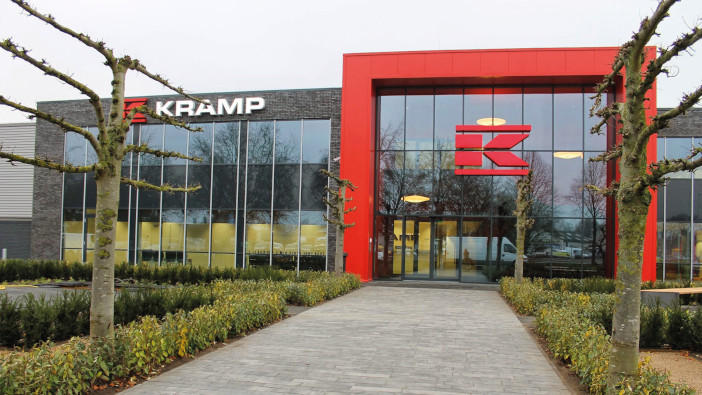
Matt Tilt headed out to the Kramp headquarters in Varsseveld, Netherlands, to see how spares and accessories are shipped worldwide and discover how the company is closing the gap between its customers and it
Kramp has announced a shift in its offering, enabling parts to be ordered directly from customers through its new eShop. While orders are taken direct through the website, which is available 24/7, the company is clear that it does not want to remove the dealer from the equation. When signing up, customers are expected to be from a legitimate agricultural, landscaping or forestry business and must choose a local dealer to be affiliated with.
Leo Copping, field sales manager at Kramp UK, explained that when a new customer signs up, the dealer chosen will be notified. “If it’s an existing customer, then the dealer will have the option to add a credit account for them. Regardless, the money from each transaction will go direct to the dealer; this just gives customers access to our ordering system even when the dealer is closed.”
Orders can be delivered to the customer or to the dealer for collection, and the company plans to work closely with their network to actively market this. “There’s a lot of potential here, not only in providing direct access to our range of products, but for dealers to increase their customer base. Customers do not have to have an existing account with the dealer, so our partners will have access to customers they have previously not worked with.”
The system has taken a lot of development and investment from Kramp; however, it expects to see a return on investment by the end of 2027 due to the increased availability and timeliness of products.
 A 75 year journey
The new eShop functionality is the next step in the company’s 75 year history. The company was founded in 1951 by Johan Kramp and created the first catalogue for industrial parts the same year. In 1969, the company started working in partnership with Perdok, which saw it expand into agricultural spare parts. The two companies worked together to expand internationally, using the Kramp name as this was a more recognised entity outside of the Netherlands.
This included the founding of Kramp UK in 1973. In the last six years, this subsidiary has invested heavily, opening a new distribution centre and headquarters in Biggleswade, Bedfordshire. This includes a 150,000sq ft storage area, stocking 90,000 of the most popular parts in the UK market, with 360,000 individual parts through the webstore.
“Around 96.8% of orders can be delivered on a next-day basis, with some parts having to come from Varsseveld, which often adds an extra day,” Leo explains. “This is where the introduction of the eShop will be particularly useful for UK customers.”
In 2000, Kramp and Perdok merged fully, retaining the Kramp name due to the greater market recognition. A series of partnerships and acquisitions since then has led to increased sales, and investments have been focused on boosting the IT systems, as 89% of sales now come online. Over 40 international webstores are maintained from the headquarters, hosting products from more than 3,000 suppliers.
International product manager, Klaas Peter Van De Pol, explained that the company is built around convenience. “We will not always be the cheapest, but we have the widest offering and quick delivery. Dealers do not want capital tied up in stock, and customers want products as quickly as possible. This is what we can offer.”
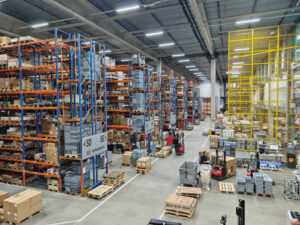
The Varsseveld site has 500,000 items in stock, with access to more than one million from its suppliers. Every morning, up to 15 trucks arrive at the site, with products being checked against the order and integrated into the existing stock.
The company has invested in automated picking on smaller parts, enabling more than 200 items an hour to be collected for orders. This is compared to less than 50/hr on the largest products available. A significant part of this is the fully automated warehouse, where robots organise and collect bins of small parts. This has 230,000 storage spaces, storing around 65% of all the stock held at Varsseveld.
Klaas says that as components become more complex, with more electronics, the automated order processing has shown its worth. Not only does it enable products to be processed quickly, but it also enables the company to track every unit that leaves the warehouse. “This means that if a warranty claim comes in, we know exactly what product went out, when it was processed and what was shipped with it.”
 From standard to custom
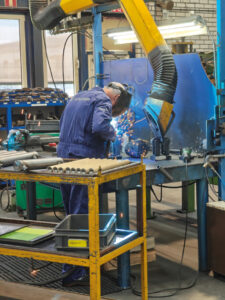
One of the unique offerings from Kramp is its technical services. Every half hour, a van from the main warehouse takes parts to technical services, where they are customised to fit bespoke or classic machinery. However, this goes further, as completely new products can also be designed at the site.
This is done through the configurator on Kramp’s webstore, and there is a technical support team, both in the UK and at Varsseveld, available to help customers decide on the specification of the product required. This will also be available through the new eShop direct-to-consumer webstore.
It goes without saying that customised parts will take longer to prepare and ship than standard units, although fairly simple customisations can be expedited, with the company aiming to ship them within two days of the order coming through.
These bespoke parts are usually hydraulic cylinders, hoses and powerpacks. Technical services also has a software team, which can help to develop control systems and terminals for customers. It’s a part of the company where significant growth is expected, especially as start-ups continue to drive electrification within different sectors.
Every part made is documented and photographed, meaning that repeat orders can be completed quickly.
There are also plans to integrate more of the technical services offering into the UK market, to speed up the delivery of simple customisations. Around half of the Biggleswade staff currently work in technical services, and Kramp plans to introduce hose assembly workshops.
Maintaining future growth
As part of our tour, we had the opportunity to speak with Rutger Bruijnen, COO. He noted that the increased global volatility was having an impact on the business, but that Kramp was still seeing growth and was putting in place new functionality. This included greater price transparency, which will be a key part of the eShop, and the use of AI to improve suggestions to customers and make finding parts easier.
“Part of this comes from the breadth of our product range,” he said. “This includes offering different quality and price levels for various parts, with the best always being genuine parts, followed by A-brands and third party manufacturers, and then our own branded products, which are aimed at price-conscious consumers.”
He added that the decline in machinery sales over the last few years did present opportunities for the company. “When fewer tractors are being sold, customers still want reliability and will spend money on maintenance and spare parts. We can offer a range of options to keep machines moving for longer.”