


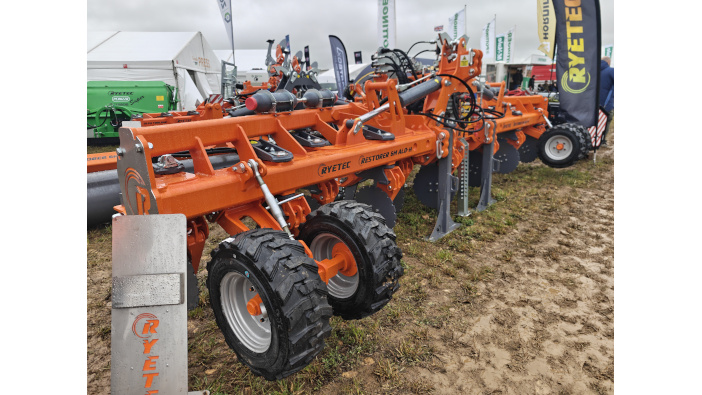
Ryetec continues to develop its Restorer subsoiler, offering a new heavy duty version for tractors from 400hp. Initially available as a 6m unit, it can be fitted with 1/2m bolt-on extensions to increase the width to 7m, or even 8m.
This version is only offered with auto-reset legs, working down to 12in or 16in depending on requirements. As with standard models, it features a rear linkage to attach a drill.
This was shown alongside the Riot three-in-one seedbed cultivator, comprising an optional front row of cutting discs, which chop trash and residues and limit the risk of blockages.
Behind these is a row of adjustable subsoiler legs, capable of working down to 450mm and spaced at 500mm, with a 260mm point-to-point stagger.
The legs can be specified with either shearbolt or hydraulic auto reset. Unlike the company’s popular Restorer range, the legs are also fixed, with no steering option.
A twin row of hydraulic adjustable discs is mounted behind, with the choice to adjust the aggressiveness, which mix the soil ahead of the hydraulic roller, with scraper system.
Retrofit CTIS system
Shown on the Ryetec stand, the Dutch-built Float Control is a retrofit central tyre inflation system, that can either be attached to the tractor’s own compressor, or placed within a Ryetec-built front-mounted box with a hydraulically driven compressor.
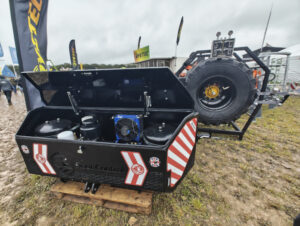 According to the company, by using the front-mounted model, which is runs on the Power Beyond coupling, inflation times can be significantly reduced.
Two control operations are available. Either a basic, lever actioned version which mounted under the rear window of the tractor. This includes a lever for each tyre and a pressure gauge, enable the operator to see the pressures of each tyre as it deflates or inflates. An in-cab system is also available, linked to the terminal.
One key advantage is that the more powerful, front-mounted unit inflates the tyres so quickly – according to the company – that operators can be back up to full speed and on the road quicker, while still benefitting from the advantages of reducing pressures in the field.