


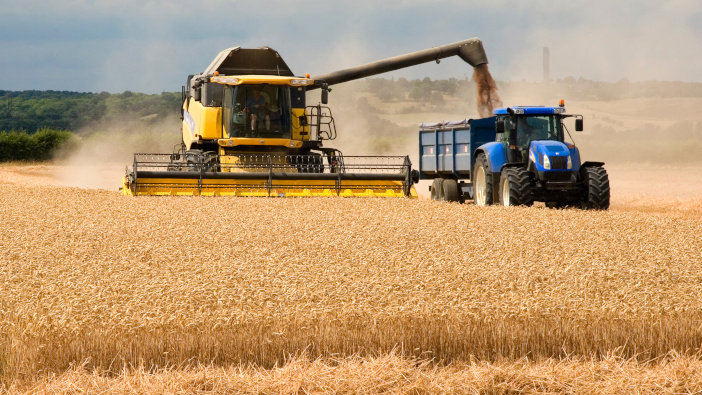
The UK has seen its earliest harvest on record. When the AHDB released its first progress report at the end of July, many combines had been running for weeks.
Extrapolating from a dataset of 60 farms, 95% of the winter barley was already harvested, 73% of winter oilseed rape was in stores, and more than half of the winter wheat was in.
While activities have slowed in the north of England and Scotland due to wet weather, it seems unlikely the AHDB will need all four reports to discuss harvest 2026.
The first report showed huge variations in yield. Average winter wheat yields dropped from 7.2t/ha in 2025 to 6.8t/ha, well below the 10-year average of 7.8-9t/ha. Some areas reported just 3.9t/ha, while others saw as much as 11.5t/ha. In winter barley, yields were between 3.4t/ha and 11t/ha. The average was 6.8t/ha, the same as last year, and within the 10-year average range of 6.2-7.8t/ha.
However, quality was good. In wheat, specific weights in Group 1 wheats ranged from 76kg/hl to 85kg/hl, with most samples over 82kg/hl. Hagberg specifications were well in excess of milling thanks to the dry conditions, and protein was high, with averages of about 14% not uncommon. The average moisture was 12.5%.
The only crop to see an increase in yield in the first report was winter oilseed rape. Yields were between 2.4t/ha and 4.9t/ha. This averaged 3.9t/ha, up from 3.7t/ha last year, at the top of the 10-year average, although the AHDB notes the long-term average includes both spring and winter crops. Moisture levels were being managed well, averaging 7.3%, and oil content was between 42% and 45%.
Two weeks later
According to the 14 August report, the downturn in yield has continued. While winter barley remains in line with the long-term average – 6.8t/ha with 95% of the harvest complete, with variation ranging from 4t up to 11t – the winter wheat average has dropped to 6.7t/ha.
This has been the fastest wheat harvest in over 20 years; 85% of the wheat has now been combined, including about 5% of the Scottish area.
Winter oilseed rape is nearing completion, jumping from 73% harvested in the first report to 95%. In Scotland, 59% of the crop has been cut. Yields have continued to be strong, with an average of 3.9t/ha. There has been some variation, between 2.4t and 4.9t, but yields remain at the top of the long-term average for the crop.
About 80% of the oat crop has been harvested, up from 32% two weeks before. At the time, average yields were 4.9t/ha, at the bottom of the long-term mean of 4.9-5.9t. As more spring oats have been harvested, the average has now dropped to 4.2t/ha, with individual blocks varying from 2t up to 9.3t.
Spring barley has moved on significantly. Only 8% of the harvest was complete at the end of July, and now more than half has been cut. About 2% of the Scottish area was estimated to have been cut at the time of writing.
According to the AHDB, this has been one of the most variable crops, with some yields ranging from 2.2t to 7.6t/ha. This results in an average of 4.1t/ha. It is 29% down on the UK five-year average, and 25% from the English five-year average. The AHDB says as harvest remains at an early stage, with anecdotal evidence suggesting a better picture in Scotland, it is too early to predict what the overall average yield will be.
Quality over quantity?
Between the first and second reports, the quality of crops has become far more variable. In winter barley, specific weights are reported to be 63-66kg/hl and screening figures are between 60 % and 95% with a 2.25mm sieve.
In malting varieties, grain nitrogen has ranged from 1.3% to 2.3%, and the average moisture is about 13.4%. This was taken from variations between 10.4% and 17.5%, with the highest figure taken from an early cut in Scotland.
For winter oilseed rape, the oil content has been reasonable, averaging 44%. This is in line with what was published in the first harvest progress report. Moisture levels have been managed well, despite the drought conditions, with an average of 7.7%.
According to the report, there is too much variation in the oat crops to draw any meaningful conclusions. Specific weights have ranged from 35kg/hl to 55kg/hl and moisture levels have ranged from 11% to 16%. This has resulted in an average of 13%.
While winter wheat yields have been down, the quality is reported to be high. Specific weights have been exceptional in Group 1 samples, according to the report, ranging from 76kg/hl to 85kg/hl, with an average of 82kg/hl.
The dry harvest has also meant that Hagberg numbers have not been an issue. The average score of 365 is well in excess of milling specification.
Protein levels have been high, albeit with more variation. Samples as high as 15.5% have been reported, although the average is 13.5%, and moisture levels averaged 13%, with some getting as low as 10.8%.
More variation has been reported in spring barley, although with just over half of the UK crop harvested, there is scope for a clearer picture. According to the AHDB, no meaningful average can be derived from the specific weights, with samples ranging from 56kg/hl to 63kg/hl. Screenings also show a large variation, with 65-95% retained by a 2.25mm sieve.
Grain nitrogen levels from 1.2% up to 2.3% have been recorded, and moisture has averaged 13.1%. Crops as low as 11% have been seen, with levels peaking at 19% in Scotland. Overall, germination has been OK so far.
Additional insights
The second harvest progress report also includes pulses, with harvest having been 59% complete by 10 August. The first report recorded 44% of crops harvested.
The eastern region is the most advanced, with all farms in the sample completing harvest. No data from Scotland or Wales has been included this season.
Yields are variable, and the AHDB said it is difficult to draw any meaningful conclusions. Some farms surveyed have reported yields reaching just 45% of individual five-year averages, while others have seen 140%.
Yield variations mean straw volumes have also varied. The East has seen lower swath sizes compared with the West, although this is not universal.
Production was hampered early on as grain matured before the straw was fit. This meant green straw going through combines. Dry conditions have also meant straw crops have been brittle, leading to challenging baling conditions and reduced quality. This has increased the risk of field fires.
In terms of prices, early indications are in line with what was seen last July and August, reflecting the increased availability. The current price is about £20/t less than the peaks seen earlier this year, but the AHDB has said this is not indicative of what could happen later this year.