


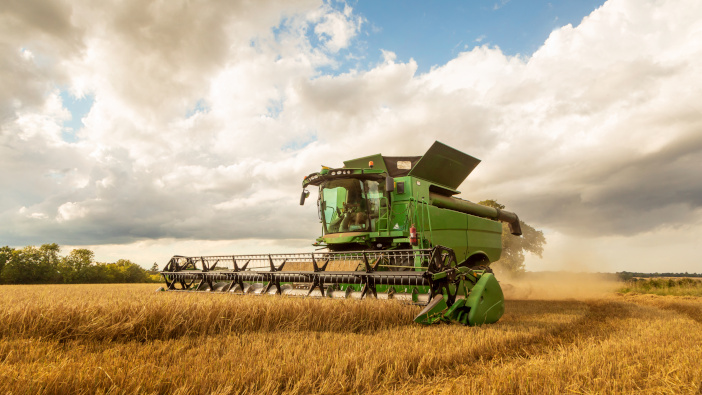
The first Agriculture and Horticulture Development Board (AHDB) Harvest Report of the year has shown that the 2026 harvest is the earliest since the organisation started keeping records in 2006.
Many farmers in the south and east of England have already completed harvest, two to three weeks ahead of the long-term average.
Anthony Hopkins, the new director of cereals and oilseeds, said: “Across much of the UK, combines have been rolling earlier than usual this year, with many farmers working through the night to avoid the most extreme daytime temperatures.
“While it’s encouraging to see oilseed rape yields improving on average, cereal yields have generally been below the 10-year average so far, with some farms experiencing significant reductions. Following successive years of difficult weather and rising costs, the financial pressures are becoming increasingly acute for those businesses hardest hit.”
The report, the first of four, also highlights how grain moisture levels have been managed in the challenging conditions and shows a more positive picture of crop quality.
Anthony Speight, senior analyst, cereals & oilseeds, said: “Although harvest has progressed rapidly across most regions, we’re seeing considerable variation in yields between farms, reflecting differences in rainfall, soil type and cropping decisions. At this stage, the emerging picture points to disappointing cereal yields in many areas, but we’ll gain a clearer understanding as harvest continues.”
Data taken from 60 UK farms, covering around 38,500 Kha, suggests that 54% of the wheat harvest is now complete. The average yield has been 6.8t/ha, down from 7.2t/ha in 2025, and well below the average 10-year range of between 7-8.9t/ha.
Significant variation was seen depending on growing conditions, regions and soil type. The AHDB notes that yields from 3.9t/ha up to 11.5t/ha were recorded.
The quality has been good. Specific weights in group 1 wheats range from 76-85kg/hl, with most samples at 82kg/hl+. Hagberg Falling Number specifications have been well in excess of milling thanks to the dry conditions, and protein is high, with averages about 14% not uncommon. The average moisture was 12.5%.
This variation was seen in other crops as well. In winter barley, yields were between 3.4t/ha and 11t/ha. The average was 6.8t/ha with 95% of the crop harvested. This was the same as last year, and within the 10-year average range of 6.2-7.8t/ha.
Specific weights are reported between 63-66kg/hl and screening levels have seen between 85 and 90% retained on a 2.25mm sieve. Malting varieties have had variable nitrogen levels, ranging from 1.7% to 2%, and moisture levels have varied between 10.4% and 16.6%, with an average of 13.3%. The AHDB notes that the higher moisture level was reported from an early cut in Scotland.
Winter oilseed rape is 73% harvested, with yields between 2.4t/ha and 4.9t/ha. This averages out to 3.9t/ha, up from 3.7t/ha last year, at the top of the 10-year average. Although the AHDB notes that the long-term average includes both spring and winter crops.
The AHDB says that moisture levels have been managed well, with an average of 7.3% and a range from 6% to 9%. Oil content has been between 42% and 45%.
Around 8% of the spring barley crop is harvested, averaging 5.3t/ha, just below last year’s 5.4t/ha but still within the long-term average of 5.2-6.3t/ha.
The oat harvest is 32% complete. The yield has averaged out to 4.9t/ha, the same as in 2025 and at the bottom of the long-term average of 4.9-5.9t/ha. Figures for oats exclude farms in Northern Ireland.
For pulses, around 44% of the crop was harvested on the 26th of July. In the east, 83% is complete according to the survey. Yields are reportedly variable, but due to the small sample size so far, the AHDB is waiting for additional information.
Finally, straw volumes have been variable, with smaller swaths in the east and larger volumes as you head west. In some cases, the grain reached maturity before the straw was fit, resulting in green straw being harvested.
Dry conditions have also seen an increase in brittle, dusty straw, making baling more difficult and increasing the risk of field fires. The AHDB states that prices are broadly similar to this time last year, though the £20/t figure reflects an influx of product to the market, rather than an indication of prices going forward.