


A long-standing part of British manufacturing, Shelbourne Reynolds has built its reputation on careful acquisitions and product development. Having worked for John Salmon Engineering, Keith Shelbourne reached out to Reynolds Engineering in the early 1970s with an offer to purchase the plant, stock and goodwill.
This started the company with an established product line of swathing headers and pea harvesting equipment. It also developed conversion kits for standard combine headers, enabling them to be used as pick-ups, and side knives for direct cutting of oilseed rape.
A decade later, it acquired Mather+Platt to bring self-propelled vining pea harvesters into the product range, although these would only remain within the business for a few years before being sold to FMC (now Oxbo).
The remnants of Shelbourne Reynolds’ work with pea harvesters can still be seen today. The rotary header was an influence on the company’s stripper header portfolio, which is a key product for the export side of the business.
“You don’t want too much material going through the pea harvester, so we took the concept of the rotary header and applied it to a cereal crop,” explains Neil Smith, who is co-managing director alongside Claire Bloomfield.
The stripper header was introduced in 1988, around the same time the company signed an agreement with MacDon to import self-propelled swathers. These were fitted with the Shelbourne swathing header. The company had found a niche in harvesting equipment.
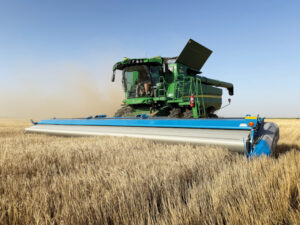 “While the stripper headers are primarily an item for export outside of Europe today, in the first year of production we sold 100 in the UK alone,” Neil says. “However, when stubble burning was banned in 1993, stripper headers lost market share. Our crops were too big and left behind too much residue.”
Adding to the business
By this time, the company had already started to expand, looking for products that would keep the factory running year round and avoiding large machines that would peak at the same time.
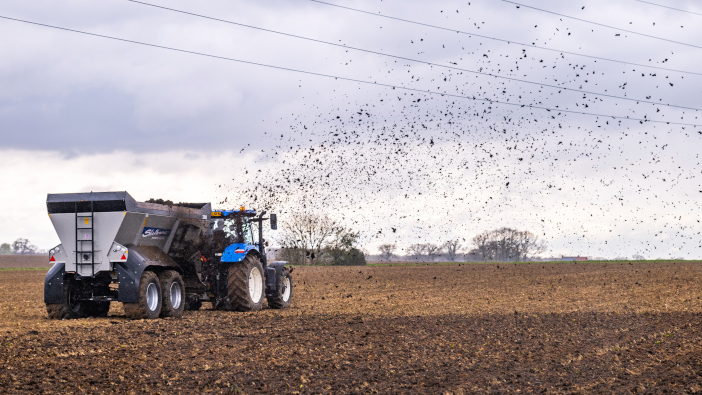
Livestock equipment made up part of the solution. In 1991, the company acquired the portfolio of Econ, including its side-discharge muckspreaders. These have become a cornerstone of the company’s product line. “Adding livestock machinery helped to insulate us from shocks to the market, and gave us another product line to develop,” explains Neil.
“The Powerspread muckspreaders had a good reputation in slurry, and we have continually built on that to showcase its ability in solid materials as well.”
Alongside the muckspreaders, the company was developing its own range of diet feeders. Neil says these remain the only diet feeders built in the UK, and they stood out on the market early on for being vertical auger models instead of the horizontal paddle feeders.
“This was a direct response to the UK conditions,” Neil says. “They could handle clamp silage and bales and had a design to suit traditional farm buildings.”
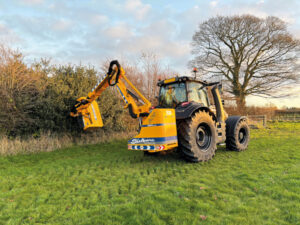 The final product range was groundcare equipment, which came in the early 2000s. Another in-house development, the company designed its own hedgecutters.
“We worked with a roundtable of owner-operators to find out exactly what they wanted from their machines, and then we targeted the high-output contractors with the first model.”
The first hedgecutter was launched in 2004 and, over the next decade, the company introduced a range of models to suit businesses of different sizes. It also developed new technologies, including hydraulic rollers and the first variable forward reach telescopic models for the UK market, launched in 2014. In 2018, it firmed up its groundcare range with the FBO flail mowers.
“We took our time and developed each of the ranges so that we could offer a premium, British-built product for our dealers,” Neil explains.
Suffolk-built, internationally sold
Alongside the product range, investment has been focused on the factory. Its Stanton site has been extended several times, in line with the company’s commitment to manufacturing in the UK.
It employs 160 people, with 100 working on the factory floor. Production starts from steel bar in the machine shop, with three laser cutters at the heart of the process. The factory also uses multiple CNC lathes and machine centres.
The 5m, 240t press brakes were updated in 2015, a necessity to improve bending technology for the robotic welders. Most of the welding is done in-house, with a small amount done locally under sub-contracts to facilitate increased capacity at peak times.
Recognising the need to bring new workers into the industry, Shelbourne runs an apprentice scheme, taking on four young workers every year. It also offers a trainee welding programme.
“Apprenticeships require the person to be in college, but not everyone wants to be in academia for that long,” he adds. “By offering a training scheme, we can help young people get into a well-paying, in-demand role.”
 Investment
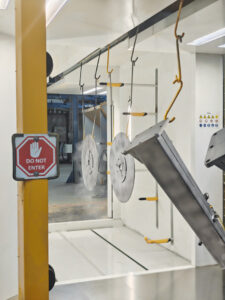
The most recent major investment in the factory was adding an automated system with cyclone recalim to the powder paint shop, installed last year.
After being manually shot-blasted, components go through the paint shop, which uses sensors to automatically switch each paint gun on and off as the parts move through. Each part is given a coat of primer, baked in the oven and then given a topcoat.
“When it was installed, I believe we had one of the largest parts ovens in the UK,” says Neil. “It’s over 40ft long and even now, we’re almost at capacity as the size of the kit has grown.”
Manufacturing is done in a single shift, although certain parts of the shop floor may incur overtime during peak periods. Neil says the objective is to keep lead times to about eight weeks, and the company plans out its production schedule up to 18 months in advance.
“The advantage of having three distinct product lines is that when one is out of season, the rest maintain the workload of the factory,” he says. “We build a few machines for stock, and our dealer network will take stock of select products. The rest are based on projected order numbers for the year.”
Constant development
Between the offices and the factory floor are the designers. Using 3D CAD software and FEA simulated testing, updates and new products are designed by a team of product specialists, one for each arm of the business, support designers and electronics specialists.
“The design process has sped up significantly, because we can now see how different materials will react when used for key components, and how the various forces will affect our machines,” says Neil. “And we no longer need reams of paper with technical drawings on them, because of the automation investments we’ve made in the factory.”
Continious development has brought about regular updates to product lines. Hedgecutters now run from long-reach, advanced machines for contractors down to smaller, simpler machines. Diet feeders extend up to twin-auger, 30cu m capacity units capable of processing in excess of 100t/day of feed.
And while the harvesting side of the business is focused on export now, Neil doesn’t rule out a return of stripper headers to Europe, especially as methods change and the changing climate affects crop yields. “Stripper headers are part of a system. Direct drills can work very well in the stripped straw, so there is potential for these machines to make a return.”
The company’s attitude is never say never. “We’re constantly assessing the market and looking for opportunities for a British-built alternative to what is out there.”