


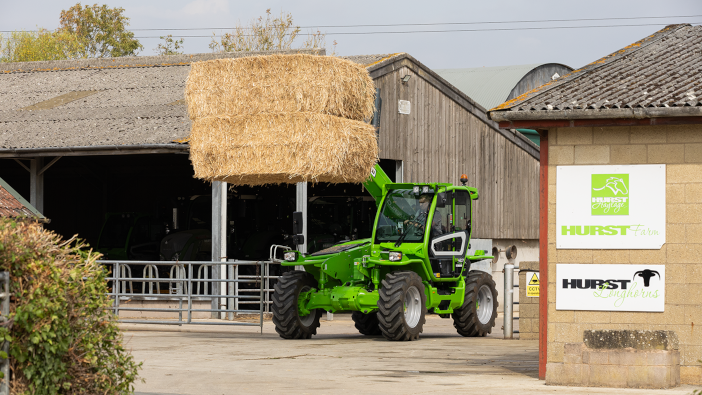
A few minor points to get out of the way first. On the day, we saw a pre-series version of the TF 42.7 CS TT CVT. This top-end model will not be available until 2027, and being a pre-series there were some parts that were not standard UK specification. The tyres were 405s, rather than 460s, and the Grammar air-suspended seat had not been installed yet.
I mention this at the start because neither of these impacted our walkaround and drive experience with the machine but are worth noting for those interested in the new model at launch.
Dealing with the alphabet soup of letters that come after the model number. CS means that the model has hydropnuematic cab suspension, which has been a longstanding selling point for the Merlo range. According to Owen Buttle, national sales manager, around 50% of all machines sold in the UK are specified with the CS system, with the rest fitted with silent blocks.
TT is the company’s boom side-shift and frame-levelling functions, enabling adjustments to be made to place material exactly where it needs to be without moving the machine. Finally, CVT is an obvious one, indicating that power is put to the ground through the company’s in-house CVTronic stepless transmission.
This is paired with a 136hp Perkins engine, which replaces the Deutz 145hp power unit previously used on CVT models. Owen notes that the switch to Perkins has simplified the range as a whole, providing commonality of parts – especially when paired with Merlo’s in-house components, which make up around 92% of the build.
“There’s better power transfer across the whole machine, and with our distributors at the back, we can achieve 138 litres/min hydraulic flow at 250bar, while handling simultaneous functions,” he says.
Cost of ownership
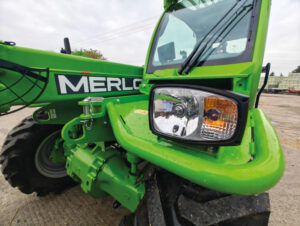
Many of the changes are practical ones. The plastic mudguards have been swapped out for bolt-on steel mudguards. These have rounded bumper-style edges for an added layer of protection should the machine encounter anything, and overhang the tyres so that the mudguards are always the first thing to hit something.
Owen explains that these have been installed to lower the maintenance cost of the Merlos. The plastic mudguards, while sturdy enough, could be damaged or ripped off. The steel units are, obviously, far more durable and, being bolt-on, can still easily and quickly be replaced should any major damage occur.
The design includes an integrated cover for the new LED working lights, so if material were to fall from the attachment, these would remain undamaged.
On the roof, the previous mesh protector has been replaced with a new fin-style guard to protect the operator from falling material. This has two benefits: the first is that it improves visibility significantly, providing a clear line of sight to the boom and attachment when working at height.
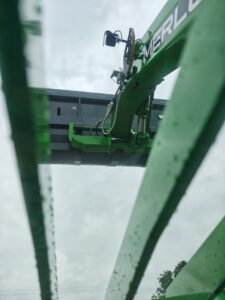 Secondly, it increases the distance between the glass roof and the point of impact, thanks to the vertical fins. This limits the risk of damage to the cab and improves operator safety.
Digital and visual overhauls
Getting into the cab has been made easier, with a more prominent lower step and a cut-out in the cab floor. For those spending long hours in the machine and jumping in and out to check gates, hook-up trailers, or changeover implements, this is a major boost to comfort.
Speaking of attachments, automatic attachment recognition is standard. When genuine attachments are mounted, the terminal in the cab will show the upper and lower limits available, and the weighing function will adjust to account for the implement weight. Through the Adaptive Stability Control System, third-party attachments can now also be pre-programmed, enabling greater functionality if the machine is overloaded.
When a TreEmme bucket or Merlo grab is attached, the terminal will show the Free Dig Zone. This enables the machine to carry extra capacity within a 1.5m height and 1.3m reach, maximising the output.
The weighing system can be operated manually, or automatically based on the movement of the boom, with up to 20 lift cycles accounted for in a single calculation.
Merlo has not opted for a touchscreen terminal, in part due to the fact that changing settings on a touchscreen when bouncing over rough fields and farm tracks can be tricky. Control comes via an encoder, which can be used to create user profiles and adjust flow rates. The machine also features an automatic engine speed function – which revs the engine as the boom is used to speed up cycle times.
To ease repetitive cycles, the company has also integrated Set Point functionality. This is activated via a button on the armrest, with a quick press to set the position and a longer press to deactivate the system. Once set, the operator uses the boom as normally until it comes time to return the boom to position. There is then a specific button on the joystick which automatically lowers and retracts the boom. It can also lift and extend the boom.
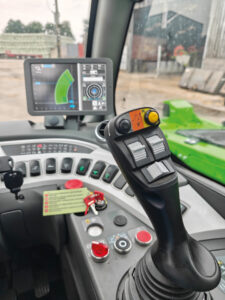 It’s also possible to lock the vertical or horizontal axis, ideal for loading pallets. This is also activated by a button on the armrest. Both of these functions worked well, although if we were going to make a minor complaint, it isn’t always clear when they have been activated. Both are shown on the terminal in the form of colour changes and additional lines across the graph of the boom movement. A pop-up would be clearer, although you would get used to this.
An evolution
Owen notes that these changes are not supposed to be a revolution, but instead a gradual evolution of a machine positioned in one of the most competitive handling sectors. And that evolution has been operator-focused.
Whether it’s the ease of access, the additional protection to reduce the total cost of ownership, or the automated functionality, these updates are not designed to change how operations are done, but to make them easier day after day.
With the right tyres and an extra comfort boost with the Grammar seat, it will tick pretty much all of the right boxes.