

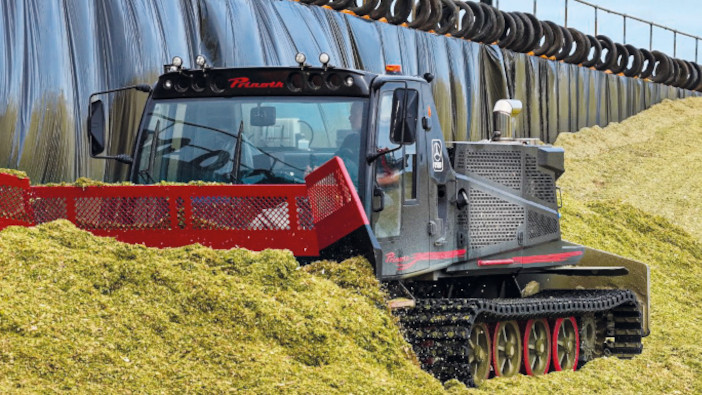
First showcased at Lamma earlier this year, the Prinoth BM430 Gen 2 is not simply a snow groomer conversion, explains Martin Bradley, managing director of Bradleys Machinery. “These specific models have been engineered for use within the green energy sector,” he says. “They were working with woodchip in Brazil, Thailand and Indonesia, so can perform in very high temperatures.”
He says this is one reason why other conversions can struggle during summer harvests. “You’re taking a machine that is designed for one thing, bolting on new parts and then putting them to work in a completely different environment, without considering the application challenges and working conditions.”
Bradleys Group is the UK dealer for the full Prinoth range, including crawler carriers, specialist tracked vehicles and vegetation management equipment. It saw an opportunity for the BM units to be usesful in agriculture, specifically for contractors working on biogas plants.
The key concern is health and safety. Tractors and wheeled loaders are not designed to work on the steep inclines and side slopes that a clamp presents, meaning there is an ever-present risk of machines rolling and tipping over.
With limited floor space on some sites, a tracked machine with a low centre of gravity and strong climbing and pushing capabilities allows steeper clamps to be formed, increasing storage volumes.
“I have worked on clamps for years. It isn’t just the physical risk,” he says. “A good operator can mitigate those, but the jolt of adrenaline that happens every time a wheel hits a soft spot in the clamp and the tractor or shovel slips causes fatigue. After a long day, that fatigue builds and accidents can happen.”
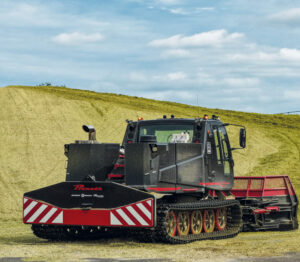 The machines didn’t exactly arrive UK-ready. The 430hp Mercedes-Benz engine only met Stage 3a emission regulations, so Bradleys commissioned an aftermarket diesel exhaust fluid system to be fitted to meet Stage V. It also added two large cooling packs to the powertrain, which provide 200% of the required cooling capacity.
“We can’t get them hot,” he says. “But it’s about the longevity and ease of maintenance. When used properly, they shouldn’t throw material up the sides and into the engine bay, but the cooling capacity means you won’t have any overheating issues if this does happen.”
Adding to this is a reversing fan, set to automatically engage every two minutes, with in-cab controls to activate it when working in dusty conditions.
Optimising power
Power is put to the ground through a hydrostatic transmission. Martin explains that driving the Prinoth requires a change of mindset.
“If you’re used to compacting the clamp with a tractor or wheeled loader, the instinct will be to put your foot to the floor, because those machines need that power to get up the clamp, especially with a load,” he says.
With the Prinoth, the engine’s power and undercarriage is optimised instead for the vibration effect on the clamp. “There is already ample horsepower and torque there, and if you try to floor it on the hardstanding before you start climbing, the tracks can slip on the concrete. Instead, you take it steady at about 1,200rpm, progressively accelerating when you hit the pile and allow the machine to work to the top.”
The tracks and speed settings are optimised for compaction, which Martin says produces the vibration effect that flattens out the clamp in even layers, removing the oxygen for ensiling.
At the front, a 16ft, 12-way hydraulic blade, with folding wings, allows for more controlled layers to be graded out. According to the company, this is also ideal for those wanting to seal the slamp with digestate and save on sheeting costs. The machine can carry the material onto the slope in layers and track it down. The front hitch can also be fitted with a buck rake and other attachments, with an easy release system and quick-coupler hydraulics.
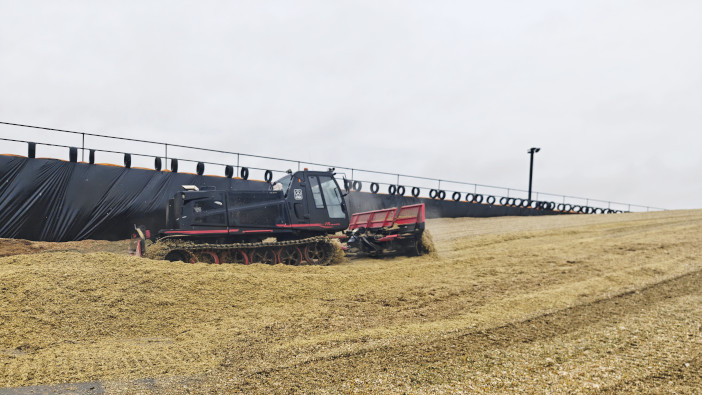
At the rear, a full-width 2.2t counterweight sits on the three-point linkage. The design of this balances the machine and enables the top to be pushed from trailer loads when reversing down the clamp, so that the machine fills the blade before ascending.
Martin sees the rear-linkage as a way to diversify and plans to show the machine with other implements, including a dribble bar, which will be useful in wet seasons thanks to the low ground pressure. A rear pto is an option.
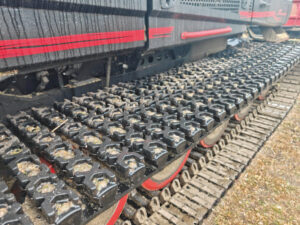
The tracks are bi-directional, with an X-pattern rubber tread that grips into the material. The tracks are the widest part of the machine, allowing operators to get right up to the clamp wall.
Martin says that clamp machines such as this have become popular in Europe. “The clamps on the continent are incredibly steep. You wouldn’t be able to drive a tractor up them,” he explains. “But they also recognise the other benefits. Being able to comfortably sit on a 45deg side slope allows the operator to do the best possible job without putting themselves in danger.”
Keeping it simple
If health and safety is the reason that people invest in the Prinoth, Martin hopes it is the low cost of ownership and efficiency that will keep them coming back. The low engine speed means fuel consumption is kept to a minimum, especially compared to a tractor.
The cab has a DAB and Bluetooth-compatible radio and a simple air-conditioning system. Everything else is there for operating the machine. The control system is all hydraulic, with no electronic components to go wrong.
Copper needles are used in the dials on the instrument panel, and copper sensors are used where required, which can be easily repaired.
Even the after-treatment system doesn’t affect performance. As it is not integral to the engine, if the AdBlue system should encounter an error, the engine will keep running at full power, enabling the customer to complete the day without incurring downtime.
For added confidence, Bradleys offers a two-year, or 2,000-hour, warranty on the units, with options for full servicing and off-season maintenance packages.
 View from the cab
Chris Mann, director of Mann Farming, is a local farmer and contractor who took on the contract for the biogas plant in 2016. This entails 250ha of rye foraging and 1,500ha of maize.
The plant insisted on tracked machines for the clamp, and Chris invested in a PistenBully. “It worked well, but it is very complicated, with a lot of electronics that can bring the machine to a standstill if they go wrong. We’ve also seen a lot of wear around the tracks, which are not cheap to replace.”
After seeing the Prinoth BM on Bradleys’ social media page, he got in touch with the company to arrange a demonstration. They had it for a week and, at the end of it, Chris asked how quickly one could be delivered to the site. It arrived shortly after.
“It’s well built and easy to drive,” he explains. “All that power goes straight to the ground, so we can quickly push loads up the clamp, and the vibrating effect creates these small, tight layers that we need for the best possible finish.”
He adds that the front and rear balance is just right, and maintenance has been simple. “Everything is easily accessible, so in the morning it’s a case of giving it a quick walkaround and making sure everything is greased up.”
The Prinoth is now the main clamp machine, with the PistenBully handling lighter duties. Chris acknowledges that the second-hand market is a bit of an unknown at the moment, which is why he hasn’t looked to drop the older machine from the fleet.
“With that said, there isn’t anything I’d change about the machine. It really is a machine for life. Our contract with the plant runs for another six years, and I can’t foresee any significant maintenance in that time. I don’t think the tracks will have even worn by then.”
He concludes by saying that if the contract were to end and he had to look for maize work with local farmers, he wouldn’t go back to a tractor or wheeled loader. “It really is the safest way to handle clamp work.”