


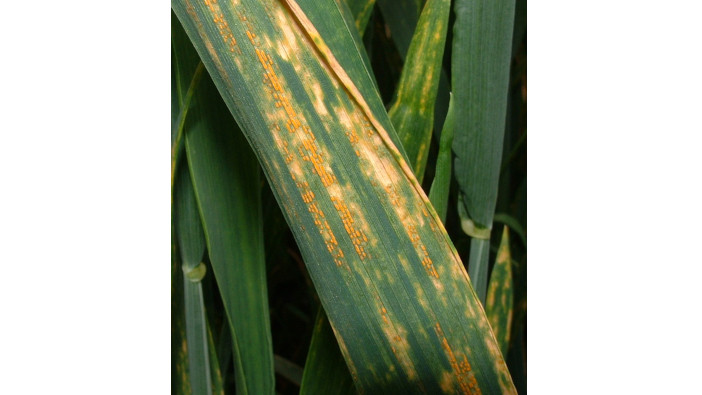
Protecting wheat crops by assessing disease risk is essential to avoid compromising yield potential or stoking problems later in the season.
Although some may look to make savings with the first T0 fungicide, a Hutchinsons/BASF trial at Terrington, Norfolk, has shown that this could be a false economy if yellow rust pressure is high. The trial discovered that under significant yellow rust pressure, a 1.5 t/ha yield could be attributed to a T0 applied to KWS Kinetic (rated 4 for yellow rust). The trial compared a full programme (T1-T3) with and without a metconazole-based T0.
David Howard, head of integrated crop management at Hutchinsons, said: “Considering the historical average yield response from T0s is nearer 0.1 t/ ha, the Terrington result is unexpected, but highlights the variability long-term averages can mask, and how challenging rust management can be once it builds in crops.”
Acknowledging that last season was particularly high risk for yellow rust, Mr Howard said that this was due to a mild winter and monthly temperatures from January onwards being around 2°C above average. Weather tracking data also showed that most areas experienced 70-80 days between January and July where temperatures were between 10 and 15°C, which was ideal for yellow rust. He said: “Under such conditions, disease cycles faster, multiplies and reinfects crops more rapidly, keeping pressure high, resulting in clear benefits from reducing inoculum early.”
This was highlighted clearly at Terrington, with leaf inspections showing less disease infection on all the main leaves, culminating in 8-10% less yellow rust on the flag leaf where a T0 was applied.
Changes in temperature

The winter cold spell has helped to reduce the risk of yellow rust by killing pustules and infected lower leaves. It has also been proven that frosts below -5°C will affect dormant mycelium. A large area of relatively early-sown wheat last autumn may further help to counter yellow rust risk.
Growers should not be complacent, however, and Mr Howard warned that the continuing unpredictable weather along with changing pathogens gives further reason for T0 sprays to become standard for early rust management.
Lincolnshire-based Farmacy agronomist Charles Wright agreed: “Rust pressure is generally lower than last year [at the time of writing at least], but don’t get complacent. Relative yellow rust risk is getting greater in the UK because of the weather patterns we’re having, so saying it’s lower risk now is somewhat different to saying that 10 years ago.”
He added that many varieties are susceptible to yellow rust, including Skyfall (rated 3), KWS Zyatt (3), and Gleam (5), but even those with higher AHDB Recommended List scores, such as KWS Extase (8) and KWS Dawsum (9), should be managed carefully. Later-sown crops, such as those after roots or veg, or where drilling was delayed due to black-grass management, may be at greater risk of yellow rust.
Timing is key
Traditionally, many growers target growth stage 30 for applying the T0, however Mr Howard said that there is greater flexibility by going for a slightly wider application window of GS 25-30 where pressure is high. This reduces the chances of weather delays rolling T0 sprays into the T1, and gives the treatment gap to lower inoculum pressure and allow T1s to be less curative and more protectant (where chemistry is most effective).
He advised that metconazole or tebuconazole-based products are preferred where rust needs rapidly knocking out, while strobilurins, such as azoxystrobin or pyraclostrobin, offer longer-lasting protection, but less curative activity.
In the most susceptible varieties, where risk is very high or yellow rust has become established over winter, there may be a need to apply a fungicide before the main T0 (from post-tillering, GS 20+), although Mr Wright recommended that growers should check with their agronomist as only a limited range of products can be used at this early timing. He favours straight tebuconazole pre-T0, allowing the true T0 to be applied at GS 30, and helping to maintain a tight 2.5-3 week interval between the T0 and T1 treatments.
Septoria
While yellow rust is the focus of most T0 programmes, early-sown wheats with high biomass will be at greater risk of Septoria, so this should not be overlooked at T0. Mr Howard said: “Some growers may have turned away from using T0s to manage Septoria after chlorothalonil’s withdrawal, but there are benefits from keeping Septoria in check and buying flexibility towards T1.” He continued, saying that Metconazole has some Septoria activity, although folpet offers greater protection.
Mr Wright added: “Generally, it’s the rainfall during April and May that really drives Septoria pressure, but early drilled crops with bigger biomass, will be at greater risk. For growers trying to be proactive against Septoria at T0, then the multisite folpet is probably my preferred option, as you’re hopefully protecting some of the new growth from getting Septoria.
“With high input prices and still decent commodity prices, any element of risk management you can bring into the situation is worthwhile.”
