


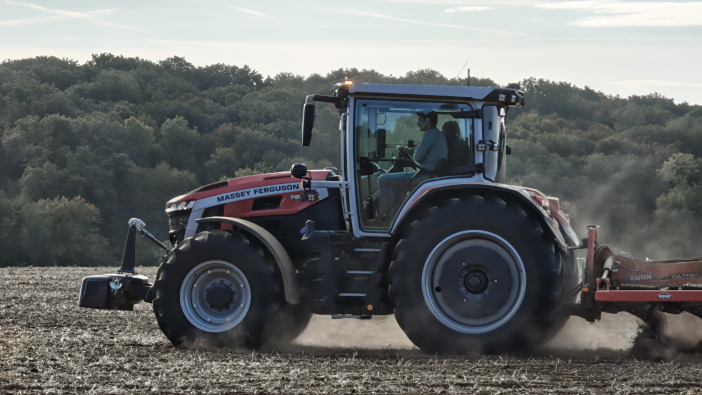
Filling a 7700-sized gap in the range, the new 7S Mk II from Massey Ferguson is set to be a hugely important model for the company
Our Tractor of the Year jury duty took us to France to see the latest products from Massey Ferguson. Headlining the event, the 7S Mk II presents an interesting proposition for the company. The introduction of the original 7S in 2021 created a gap in the company’s portfolio. These models had the power output, but lacked the weight and wheelbase of the 7700-series, and the jump to an 8S machine did not suit every customer.
Massey Ferguson recognised this. Marco Lombardi, sales director for Europe and the Middle East, says the 7S Mk II will slot into an important market sector, representing about 15,000 tractor registrations in Europe alone. “We didn’t have the right machine for that 250hp market,” he says. “With this new six-model range, we fill the gap between the 7S and 8S Xtra, and bring back an important tractor size for our customers.”
Under the bonnet, there is a new-generation Agco Power Core 75 six-cylinder engine. It uses no exhaust gas recirculation and has a single-turbo set-up. Rather than incorporating a boost system or engine power management, the engines are tuned on a single power curve, distributing power based on demand. The torque
curve also remains flat between 800rpm and 1,500rpm.
Engine outputs range from 170hp up to 245hp, with torque levels between 815Nm and 1,184Nm. Notably, this now means Massey Ferguson can offer a total of 17 models, from the 5S up to the 8S Xtra within the 150-250hp range, a key power segment for fieldwork in the UK.
 Each model is fitted with the Agco-built Dyna-VT ML180 continuously variable gearbox, branded as the Vario gearbox elsewhere. When asked why the company has not moved to the VarioDrive transmission, seen on flagship Fendt models, Marco says that while the system has benefits, it is far more complex, as well as larger than the ML180.
The wheelbase has been extended to 2.95m, increased from 2.88m on the original 7S, and shorter than the 3.05m wheelbase on the 8S Xtra. The company clearly wants its customers to maximise uptime with these new machines, as it has increased the fuel tank capacity by 25% compared to the original 7S, to 410 litres, and the AdBlue tank is up to 56.5 litres, 88% larger than the previous model.
At the rear of the machine, there are three options for the hydraulic pump. All are closed-centre, load-sensing systems with flows of 110, 150 or 190 litres/min.
Depending on the specification level, up to five electric spool valves can be specified, each delivering up to 120 litres/min and with decompression levers. The rear linkage can handle up to 9.6t, and the rear pto is four-speed as standard.
New cab, new controls
The cabin from the 8S Xtra has been brought to the 7S Mk II, retaining the Protect-U 15cm gap between the cab
and the engine bay to minimise noise, heat and vibration.
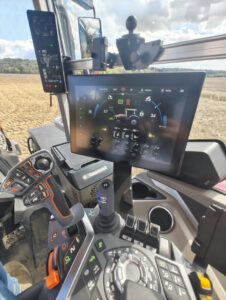
The Datatronic 6 terminal has been updated, now extending to 12in and combined with a larger processing system, which means it runs up to 90% faster. It brings with it a fully adjustable set of working pages, capable of running up to 16 tiles on each. This allows operators to fully adjust the layout of the terminal to suit their needs.
Depending on the specification, there is also the option of an Isri TT Deluxe electronically adjusted leather seat,
offered as an alternative to the Grammar seat. Its category 2 filtration system can be upgraded to category 4, with separate filters to increase the working life. Other options include a hot and cold box and an advanced sound system that generates low-frequency vibrations against the windshield to mimic a subwoofer.
It can be further customised with MF By You options. Marco notes that more than 30% of tractors now go through the MF By You workshop at Beauvais before being shipped.
 The driving experience
The larger cab of the 7S Mk II could prove to be a game-changer for the company. It is comfortable, with excellent visibility, and it’s quiet as well.
The Datatronic 6 is easy to use, with smartphone functionality and clear, pictorial icons, while the control scheme
on the armrest retains the same logic as the rest of the Massey Ferguson range, so those familiar with the brand will be able to easily jump between machines.
This is combined with proven components, such as the transmission and Agco Power engine, which meant it
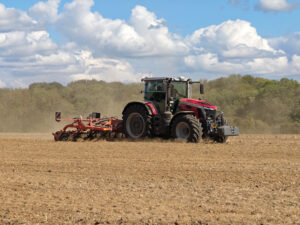
was simple and powerful as we worked in the field, easily handling the cultivator on the back.
Alongside the new screen, there have also been updates to the precision farming systems, including tractor implement management steering through the Isobus port, K- and Y-type automated headland turns and tramline control.
These position the 7S Mk II as a real field machine, with the increased maximum weight and larger tyres making it a more attractive proposition for some operators than the original 7S, which means they do not have to opt for the larger 8S.
However, for those who still want the original 7S, or want transmission options beyond the stepless box offered here, these six models will be available alongside, instead of replacing the 7S. Deliveries are due to start in January, with small numbers initially before production ramps up.
“Dealer training is going to be crucial going forward,” says Marco. “We can now offer a wide range of machines in this key power segment, so dealers will need to match the correct model to the requirements of our customers.”
Stepless transmission comes down to 5S
When we visited Massey Ferguson last year, we were impressed with the 5M-series and its performance on a steep slope with a tine cultivator. This year, we got our first opportunity to get behind the wheel of the higher-specification 5S with a continuously variable gearbox.
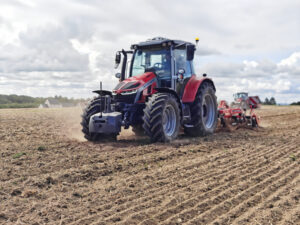 The single-range, Agco-built transmission has a 40kph top speed, achievable at 1,550rpm, and operators can
save two virtual speed ranges and recall them using the control lever.
Dyna-VT machines have the same 2,550mm wheelbase, but are slightly heavier, leading to a 500kg increase in the
gross vehicle weight to 9,000kg. The five models offer power outputs from 105hp up to 145hp, each with a 6,000kg rear linkage and load-sensing hydraulics with a maximum output of 110 litres/min, with control of the first and second spools through a micro joystick on the Multipad lever.
We had the opportunity to test this machine with a cultivator on the back, and one with a loader. The latter impressed thanks to its steep bonnet, giving us a far greater view of the bale spikes, while the controls were simple and intuitive.
As for the unit with a cultivator, we weren’t able to test it on a slope, but with the transmission working by itself, we were able to focus on the job being done. While it is a little cramped when you jump straight from the 7S Mk II, it’s still a comfortable and quiet drive.
We could have quite happily sat in there all day.