


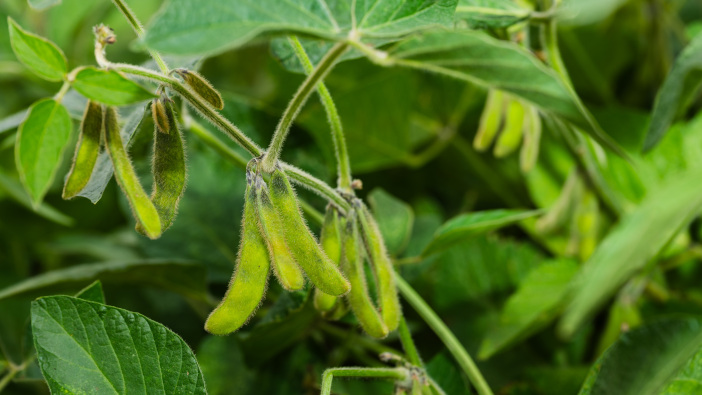
“We could be at the start of something exciting,” is how Dr Nancy Podevin described the work at Corteva’s soya bean research centre at Warwick University.
Corteva is looking to develop varieties that mature earlier to make them more suited to Northern European conditions, and the early signs are promising.
Early maturing varieties are available; the problem is their performance. “Soya can be grown in the UK. The challenge is developing varieties that flower and mature early enough to fit UK farming systems while still delivering the yield and protein levels growers need for profitability,” said colleague Dr Frank Röber.
Soya beans are a short-day crop, so in a regular UK summer, flowering and maturity are delayed. The challenge is achieving earlier flowering without sacrificing yield potential, because many ultra-early maturity lines carry a yield penalty.
With the Precision Breeding Act passed, the UK is the perfect place to test advanced breeding techniques, and Corteva believes sustainable and viable soya production in the UK is possible. Warwickshire is one centre of a network across Europe and the USA.
In greenhouse tests, Corteva has been able to accelerate flowering by up to 20 days, but to truly test the potential of new genetic material, it has to move to the field.
Frank pointed out that soya is more protein-rich than many other legumes. “Soya bean seed protein content is typically 36-40% where with field beans it is only around 26-30%,” he noted.
What Corteva is working on is simultaneously targeting the repressor genes that suppress flower development to produce what Frank calls ‘super early’ varieties. Using CRISPr-Cas9 breeding technology, it has taken a number of later, higher-yielding varieties and induced flowering earlier.
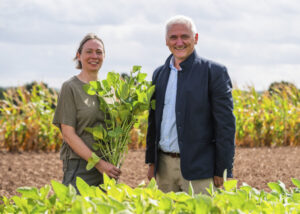 Walking through the plots in early September, the difference was immediately visible. While a number of later-maturing, high-yielding varieties were still flowering, their edited relatives were setting seeds and had yellowed. “This is beyond my expectation,” said Frank. “We have proved that by knocking out a few genes we can move a variety from early to very early.”
Frank admitted the summer heatwave had probably helped this season. When asked whether climate change would negate the value in its breeding programme, he replied that even if UK summers become warmer, soya beans will remain highly responsive to day length, not just temperature. Photoperiod sensitivity is a fundamental biological constraint. Earlier flowering therefore remains important for reliable maturity and harvest timing.
Developing varieties more suited to UK conditions and cropping systems will also allow UK growers to gain from soya’s rotation benefits.
As with other legumes, soya beans derive a large proportion of their nitrogen requirement from biological fixation through their partnership with the rhizobium bacterium.
Soya also has a deep rooting system which Frank said can do “wonders” for soil structure. However, he pointed out UK soils generally lack established soybean-specific rhizobia populations, so effective inoculation is essential for reliable nitrogen fixation. Corteva is also testing biological options here.
Flowering and maturity are only the first steps. An important goal will be ensuring yield, protein and harvest consistency in the face of increasingly variable weather conditions. If successful, the first batches of commercial seed may not be that far away. Further agronomic testing will be followed by official variety trials.
Although pest and disease threats are few, Frank pointed out that soya beans can suffer from rusts and sclerotinia, and from intriguingly named ‘stink bugs’. The brown marmorated stink bug has a particular liking for the crop and has recently been observed in the UK, although breeding has not been recorded.
Frank described his job as developing plants that produce as much as late varieties but flower earlier, but even if successful, he admitted this might not be enough. Reliable supply chains, processing capacity and end markets will be essential for widespread adoption.
From a peak of around 3,000ha in 2019, the UK soya bean area has fallen, and currently Soya UK has suspended contracts.
David McNaughton says the US is ‘awash’ with cheap soya and with what he considers a poorly structured SFI, the sums for soya just don’t add up. “Soya meal is currently trading at around £340/tonne whereas a few years back UK-grown non-GMO beans could attract a decent premium which would help to take the price well above £500/tonne. China’s retaliation to US tariffs has hit everyone, including US farmers,” he said.
Coupled with an SFI scheme that has offered growers several lucrative and easier options, all with a guaranteed income, it has helped push growers away from spring cropping.
But the market fundamentals remain, and David sees soya prices as being artificially low right now. “The rate of protein production isn’t matching population growth. This will have to be addressed at some point in the future,” he noted
Soya UK continues to invest in varietal development and agronomy, which it says has improved over recent years. It expects to reboot the soya programme with new varieties in a few years, provided political changes in the USA and the end to the war in Ukraine result in the soya market returning to normal.
Model supports UK-wide soya production
A Rothamsted Research study also reported that soya beans could be more widely farmed in the UK.
Over three years, Rothamsted researchers grew 14 different varieties at two sites in England, and then used modelling to extrapolate the results to 26 sites across the UK.
In addition, the model was used to predict how soya beans would mature and the associated yield using weather data under current, near-future (2041-60), and far-future (2081-2100) climate scenarios.
The study found that based on the estimated price of soya bean and associated variable costs, a 2.0 t/ha crop could result in a profit comparable to that of field beans.
Lead author Kevin Coleman said: “Our results suggest that by 2050 soybean should be a viable crop across most of England and South Wales.
“Yields would be enough to make it an economically attractive option for farmers, with the added benefits of reduced nitrogen fertiliser needs and the fact that soya beans have very few pests or diseases here. Under climate change models, some of these varieties are likely to mature as far north as southern Scotland.”
The report also stated that providing UK varieties can match the quality of imported soya beans that local markets should be found.
Delight at UK legislation
“I’m delighted to be here in the UK,” noted Nancy. She considers England’s precision-bred organism legislation as vital. “Across Europe, all the research is in the lab, but here we can go into the field. If you can’t get into the field, it limits the value of the research.”
The EU has a different legislative framework for plant breeding, which it terms new genetic techniques (NGT).
NGT-1 applies to plants with a limited number and type of changes that could have occurred through conventional breeding. Once it has been verified that they meet the criteria for NGT-1 status, these will be treated like conventional plants.
NGT-2 is for plants that have undergone more extensive or complex genetic modifications. These are covered by the existing strict GMO rules and will be subject to risk assessment. Breeders must obtain an authorisation before being commercialised in the EU.
Corteva is committed to gene editing and both Nancy and Frank feel the EU attitude is shifting. “The benefits from a production or environmental perspective are just too great. Gene editing is targeted, precision editing of the genetic code, it’s really no different to editing a sentence.
“Through GMOs, US maize growers have been able to maintain yields using significantly less water and nitrogen than conventional varieties. I am working with maize to boost disease resistance and cannot imagine anyone who wouldn’t want to see crops receive fewer sprays. Gene editing is a game changer.”
