


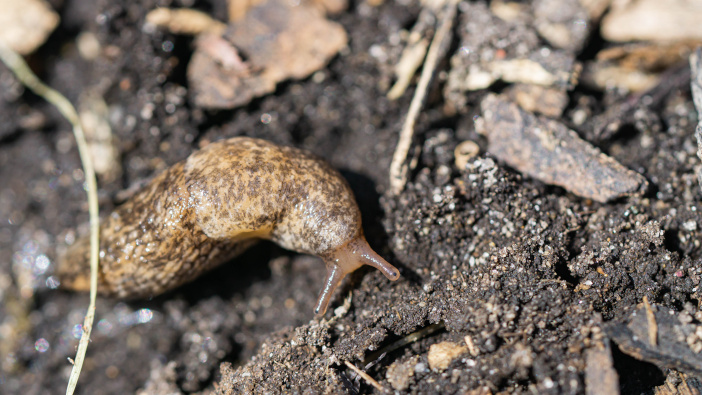
We get a glut of acronyms to kick off the event in County Durham. Bofin (British On-Farm Innovation Network). Slimers (Strategies Leading to Improved Management and Enhanced Resilience Against Slugs). But behind the word count-eating titles, the three-year, £2.6m project has focused on minimising the risk of slug damage in crops.
Slug damage is estimated to cost £43.5m each year, although the past two years have seen reduced numbers due to the dry conditions. Bofin worked with seven partners, UK Agri-Tech Centre, Harper Adams University, John Innes Centre, Agrivation, Fotenix and Farmscan Ag.
Farmers were a key part of the project, with 48 growers taking part, deploying more than 7,600 traps and conducting over 100 on-farm trials. A proportion of the funding was used to pay the farmers for their efforts, totalling £239,795.
It wasn’t all smooth sailing. The Small Robot Company initially joined the project, with a view to developing slug monitoring and mapping, and potentially control applications, as a ‘farming as a service’. When the company went into liquidation in February 2024, Farmscan Ag and Fotenix stepped in to offer a mechanised solution, but Tom Allen Stevens, founder of Bofin, noted that the changeover stopped some aspects of the project coming to fruition.
Successes
The groundwork has been set, though, for mechanised solutions. More than 3,000 slugs were captured using the traps. These were placed in 1ha grids, with 100 in each grid. The results from these were twofold. The grids enabled the partners to monitor slug activity, with the data used to create risk maps. Harper Adams’ Keith Walters said it was already known that slugs do not spread themselves evenly across the field.
“Through the project we were able to understand how they migrate, because in each field the patches of slugs followed similar behavioural patterns,” he said. “Moist clay soils are highly favoured, with silt also attracting groups. High organic matter and acidity increases the density of slugs.”
 The resulting maps, built using existing soil-mapping technology, suggest 19-86% of each arable field is at risk from slugs (averaging about 50% of a field). This makes the blanket broadcast of slug pellets and other actives difficult to justify, so the risk maps could be used to reduce applications. One trial monitored by Agrivation found 59% of the entire slug population of one field in just 20 traps. This shows the importance of targeted applications.
Over the course of the project, Bofin also worked on a digital quadrant smartphone app. Developed by Insight ML, the artificial intelligence (AI)-based system will provide crop counts and emergence details from a smartphone photograph.
See and (maybe) spray
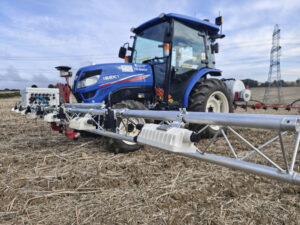
Digital monitoring is a key part of the Fotenix system, which has developed software to assess multi-spectral camera imagery. It uses an adapted camera boom on a tractor-mounted A-frame to monitor the ground and detect slugs.
This is no easy feat considering some of the most damaging species (Deroceras reticulatum, the grey field slug) are small and blend into the soil and organic matter. They also primarily come out at night, meaning that a lighting rig is required for the camera system to work.
This is where the late arrival of Fotenix and Farmscan Ag has affected the project. The Small Robot Company planned to have a commercial-ready unit by the end of the project. The two companies have the individual components, but they don’t quite speak to each other just yet.
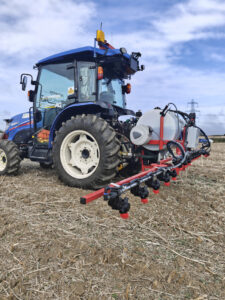 The Australian company has a spray rig with 25cm spacing, reportedly capable of patch-spraying with 99% accuracy at 1-3kph, and 90% at 6kph. The plan will be for the AI detection system from Fotenix to talk to the Farmscan Ag setup and create a see-and-spray system. This would apply nematodes.
Kerry McDonald-Howard from the UK Agri-Tech Centre said they are currently testing new nematodes (Phasmarhabditis hermaphrodita and P. californica) which infect slugs and kill them within 21 days. “It’s expensive, but this cost would be limited with an effective spot-spraying system,” she said.
Slug-resistant wheat
In July this year, the project achieved possibly its biggest leap forward in limiting slug damage. Scientists at the John Innes Centre identified key genetics for the breeding of slug-resistant wheat.
Varieties from the Watkins Collection were screened using feeding tests for their natural resistance and Watkins 788 stood out, which was crossed with commercial variety Paragon and trialled.
The reduction in slug numbers due to the drought conditions this year has made it difficult to draw clear conclusions, but the markers identified will make it possible for commercial breeders to produce resistant varieties in future.