


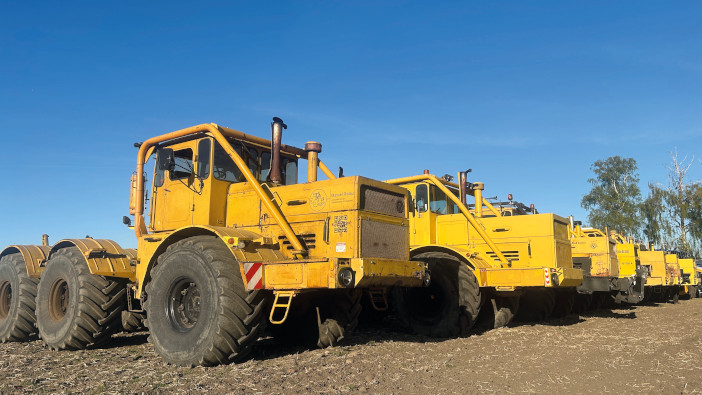
Situated about 40 miles east of Berlin in Germany’s Oderbruch region, near the rural village of Bliesdorf, is the agricultural contracting business solely operated by Manuel Ristau. Kirovets tractors have long been associated with heavy-duty work, including ploughing, cultivation, silage clamping and forestry. For Manuel, however, the capabilities of a conventional K700A were not enough.
Having trained as an agricultural and construction machinery mechanic at Tiede Landtechnik, Manuel subsequently participated in working demonstrations throughout Germany and eastern Europe. This experience helped him develop a particular interest in machinery, including Soviet-era equipment and conversions.
He then established his own contracting business, specialising in subsoiling and deep cultivation work with a Kverneland DTX 300, alongside forestry jobs and machinery conversions. In addition to his 6×6 K700A, Manuel also owns a standard Kirovets K700A and a classic East German-built Famulus, while his workshop is regularly used to repair Soviet-era ZT Tractors.
“An expensive hobby has to remain affordable,” he says, explaining his work assignments.
Why the 4×4 K700A was not enough for the German soil
“Where I come from, in the Oderbruch region, there are many ‘heavy’ soils that require deep tillage,” he explains. While a modern John Deere 8R 410 or 8RX might appear the logical choice for such demanding work, Manuel believes the Kirovets offers many of the qualities he requires.
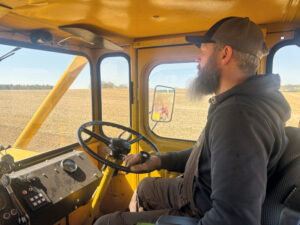 With approximately 225hp, 50kN-class drawbar strength and strong traction, the K700A provides plenty of capability despite lacking the technology and precision farming systems found on modern tractors.
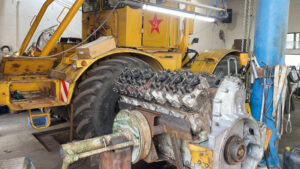
The successor to the K700 and the K700A, the K701 (manufactured from 1975 to 2001), uses a V12 engine producing about 300hp. Manuel also points to the robust and relatively simple construction of Soviet machinery as an advantage, making the Kirovets comparatively straightforward to maintain and repair when compared with modern tractors in a similar power bracket.
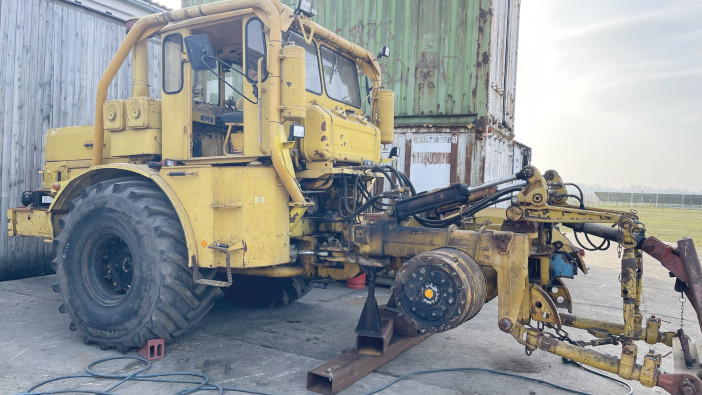
However, with greater power and traction required, Manuel’s first step was to increase the tractor’s footprint and allow it to place more force to the ground. He fitted the Kirovets with a third axle before replacing its original V8 engine with a much larger V12.
The inspiration for the conversion came partly from Russia, where three-axle K700 and K700A tractors are relatively common. Many have been modified to carry tipper bodies, following a similar principle to the Mercedes Benz Unimog.
Modifications prove their worth
Manuel believes the modifications have proven highly successful. Initially, he was only able to till ‘with a maximum of three shares at 50cm into the soil… now, [he] can drive with all five on hard, dry ground’.
For comparison, a production Kirovets K701 is rated at about 330hp and weighs approximately 13t. Following Manuel’s extensive overhaul of the V12 Yamz 240 engine, his 6×6 K700A is estimated to produce 450hp and weighs nearly 20.5t. The tractor runs on six wide Rosava 28.1 R26 tyres and is equipped with fully hydraulic steering.
While considering compatible Michelin or Belshina tyres, Manuel ultimately opted for Rosava due to their value for money and ‘unbeatable quality’ for the price.
 The tractor has a top speed of 30kph and uses a manual transmission with four forward and two reverse gears. Manuel has retained the original Russian wording on the tractor’s dials, preserving some of its Soviet character. Despite being significantly heavier and longer than a standard K700A, Manuel says the 6×6 is surprisingly similar to drive, with the only noticeable differences being its wider turning circle and the restricted view of the rear hitch.
The additional axle has also proven to be beneficial in the field and during road transport, and he says: “It also runs more smoothly, both in the field and on the road; it handles with good speed [the Müller Mitteltal low-loader] and very well on the road and farm tracks too”.
The four-wheel drive to the rear axle can be disengaged, as on Manuel’s 6×6, providing a useful option when travelling on the road.
Despite the scale of the project, Manuel was able to complete the conversion and test-drive the Kirovets in just five days. The most challenging aspect was modifying the differential, with the centre differential converted to an open design.
He then extended the tractor’s frame, accounting for the narrower dimensions towards the rear of the K700A to ensure the codified chassis remained correctly proportioned. At the rear, he extended the hydraulic oil lines and replaced the original hoses with a neater installation.
Aside from everyday agricultural work, the Kirovets is a regular fixture at large-scale farm shows, tractor-pulling events and tillage demonstrations. At events like Traction Bootcamp in 2025, the K700A was showcased pulling a 6m-wide Pöttinger Terria 6040 cultivator alongside other high-horsepower giants, including a John Deere 9RX, a Case IH Quadtrac 715 and a pair of Claas Xerions.
 Demand for Soviet-era kit
Although tractors from mainstream manufacturers remain widely available, Manuel says many farmers in eastern Germany are returning to ‘tried-and-tested’ machinery. He compares this to the continued use of classic John Deere 7810s or Massey Fergusons on UK farms, where proven and easily maintained machines can still have a place.
A major attraction of Soviet- and East German-era tractors is their mechanical simplicity. Unlike many modern machines, they can often be repaired and maintained by their owners without the need for diagnostic laptops or sophisticated electronic programming.
Combined with relatively low purchase prices and a reputation for durability, Manuel believes this makes the machinery particularly attractive, with its reliability described as ‘unbeatable’. “You can leave it unused for a year, and it will start without issue and purr like a kitten,” he says.
According to Manuel, one of the biggest barriers facing Soviet-era machinery such as those engineered by Kirovets, Belarus, XTZ and Rostselmash is the perception that these machines have very high fuel consumption and outdated engine technology. However, he insists this ‘is not the case at all’.
Compared with newer tractors of a similar power rating, Manuel says his Kirovets offers high reliability alongside greater power, traction, strength and working speed, while also consuming less diesel. He does, however, acknowledge that the St Petersburg-built machine is not without its drawbacks.
“Admittedly, yes, it is an old tractor, and things do break down occasionally, but most issues are minor and can be sorted out directly in the field with just a few quick fixes”.
One stereotype of eastern European tractors that he does support, conversely, is their ride and overall operator comfort. Compared with modern Western tractors and, in fact, new Kirovets models, such as the 516hp K-9520 and 460hp K-746M, his K700A is basic by comparison. It has no air-conditioning beyond the cab windows, no integrated heating system and produces considerable noise during both fieldwork and road transport.
To reduce the noise, he has modified various sections of the cab with aluminium butyl. The V12’s roar remains prominent, although this is perhaps less of a problem for Manuel than it might be for some operators – he says he enjoys the sound of the engine very much.
