


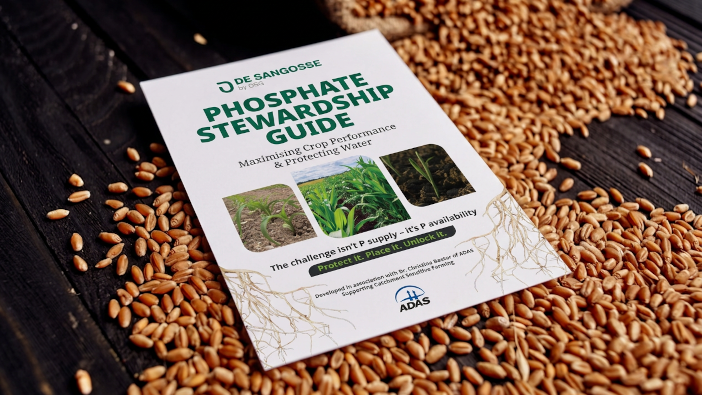
De Sangosse has announced a new phosphate stewardship hub and clinic video series to help growers and agronomists understand the factors that can limit phosphorus uptake.
The online hub will include step-by-step phosphate management guidance, based around the principle that it isn’t how much you apply, but how much the crop can access.
- Review the harvested crop: Understand what the previous crop captured using harvest performance, grain analysis and phosphorus offtake.
- Understand the limitation: Explore how access, availability and existing soil reserves influence phosphorus uptake.
- Diagnose the problem: Bring together soil analysis, grain analysis, root assessments, establishment and field observations to identify potential limitations.
- Build a strategy: Use the Protect • Place • Unlock framework to match the stewardship approach to the limitation.
- Complete the journey: Consider how improved phosphorus efficiency supports both crop performance and water quality.
Dr Christina Baxter, senior research scientist at ADAS, says harvest provides a particularly useful opportunity to assess what has happened during the season.
“The harvested crop is effectively the report card for the season. Grain analysis, combined with yield information, can be used to calculate actual phosphorus offtake and provide greater insight into how effectively the crop has captured phosphorus.”
Supporting each stage will be the phosphate clinic video series with Dr Baxter and De Sangosse commercial technical manager Rob Suckling.
Rob says the objective is to help growers turn phosphorus science into practical decisions.
“Rather than starting with what to apply, we want growers and agronomists to start by asking what is limiting phosphorus uptake. Once you understand whether the challenge relates to access, availability or utilisation of existing soil reserves, you can make a much more informed decision about what needs to change.”